Response Tiers
T0–T5configurable ladder
 WarrenBarr
Every privileged action carries a canonical string — the job, the target box, the grant id, the window it is valid for, and a signature over all of it. An attacker who reaches the network can copy that string. Change any field and the signature no longer matches; reuse it later and the window has closed. Pick an attack and watch which check fails.
For an MSSP, that gap is the whole business risk. You put your name on a client's security posture, then find out about the breach the same week the client does — from a ransom note, not your own tooling. The tools that were supposed to catch it were busy generating alerts no one had time to read.
The industry's answer has been more: more sensors, more alerts, more dashboards, more analysts to triage the noise. That doesn't close the gap; it just moves the fatigue around. Every added tool is another vendor, another console, another integration seam for something to slip through.
Security isn't about stopping everything — nothing stops everything. It's about making sure that the moment an attacker does get in, they hit a tripwire immediately, and the response that follows is automatic, contained, and recorded. Detection measured in seconds, not months.
Because it's one stream underneath, a mine trip, a heartbeat silence, and a network-drift event all land in the same feed, on the same incident thread. Nothing is stranded in a separate console. And that stream has three properties that, together, are the reason a single operator can run an entire fleet without fear:
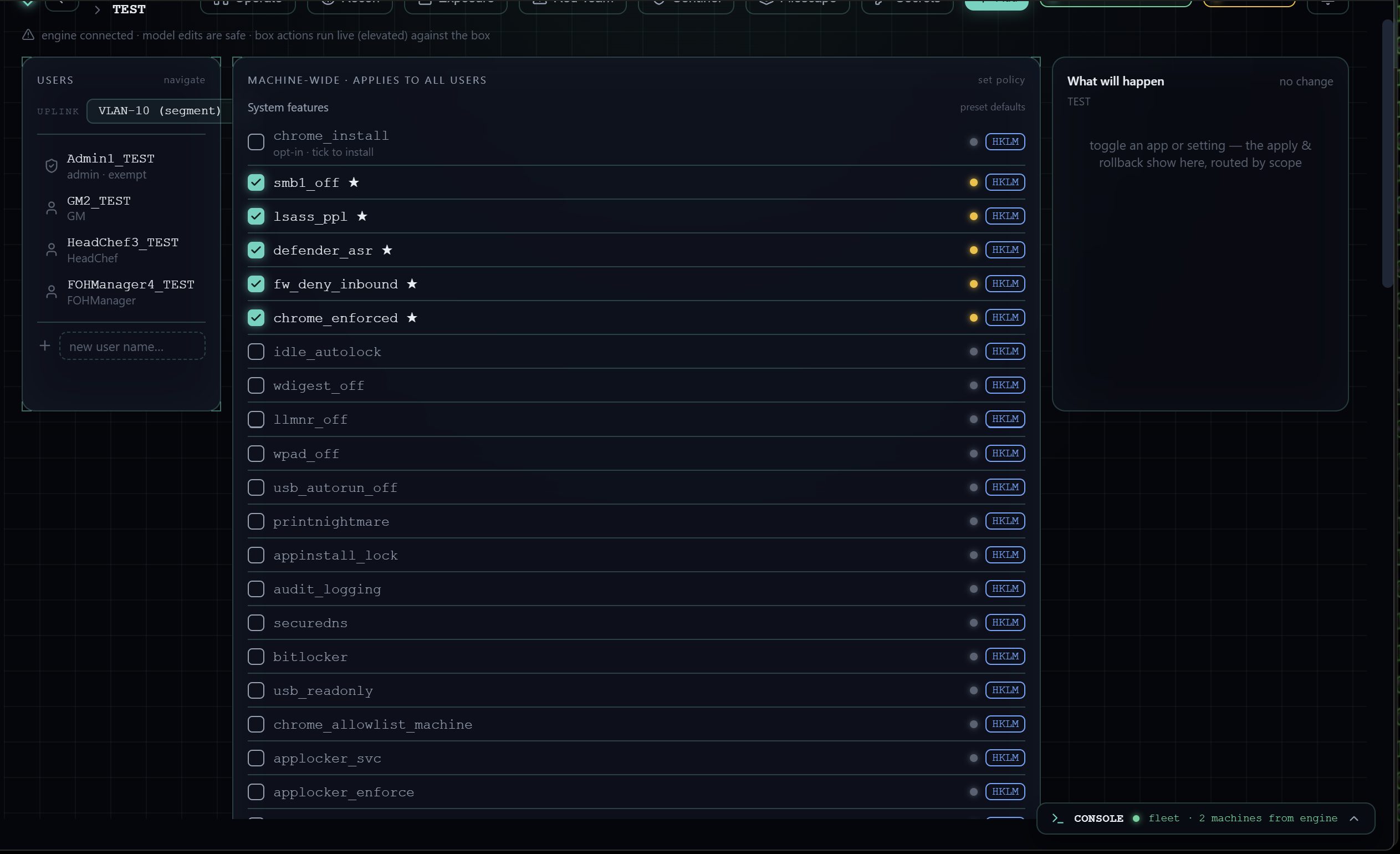
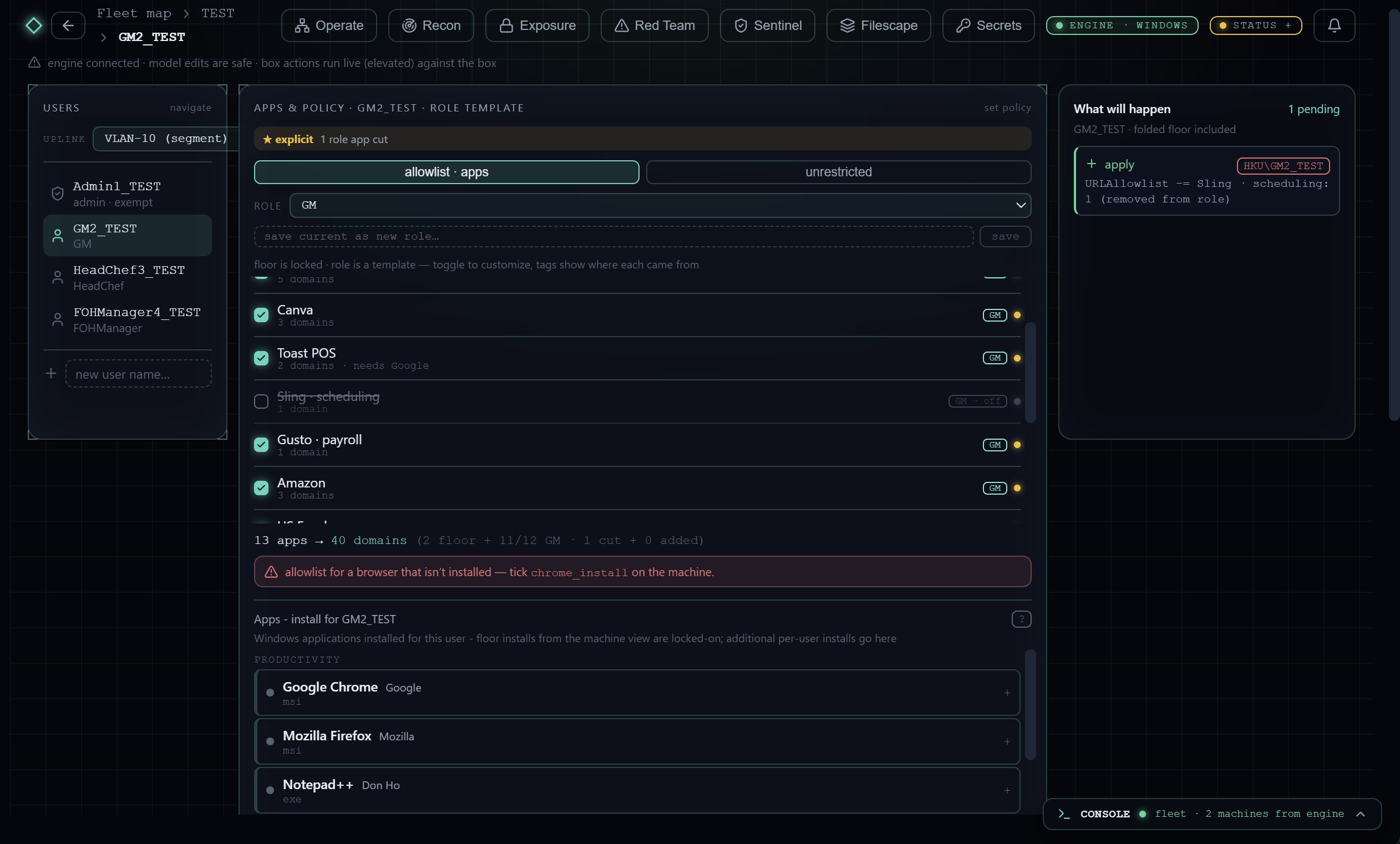
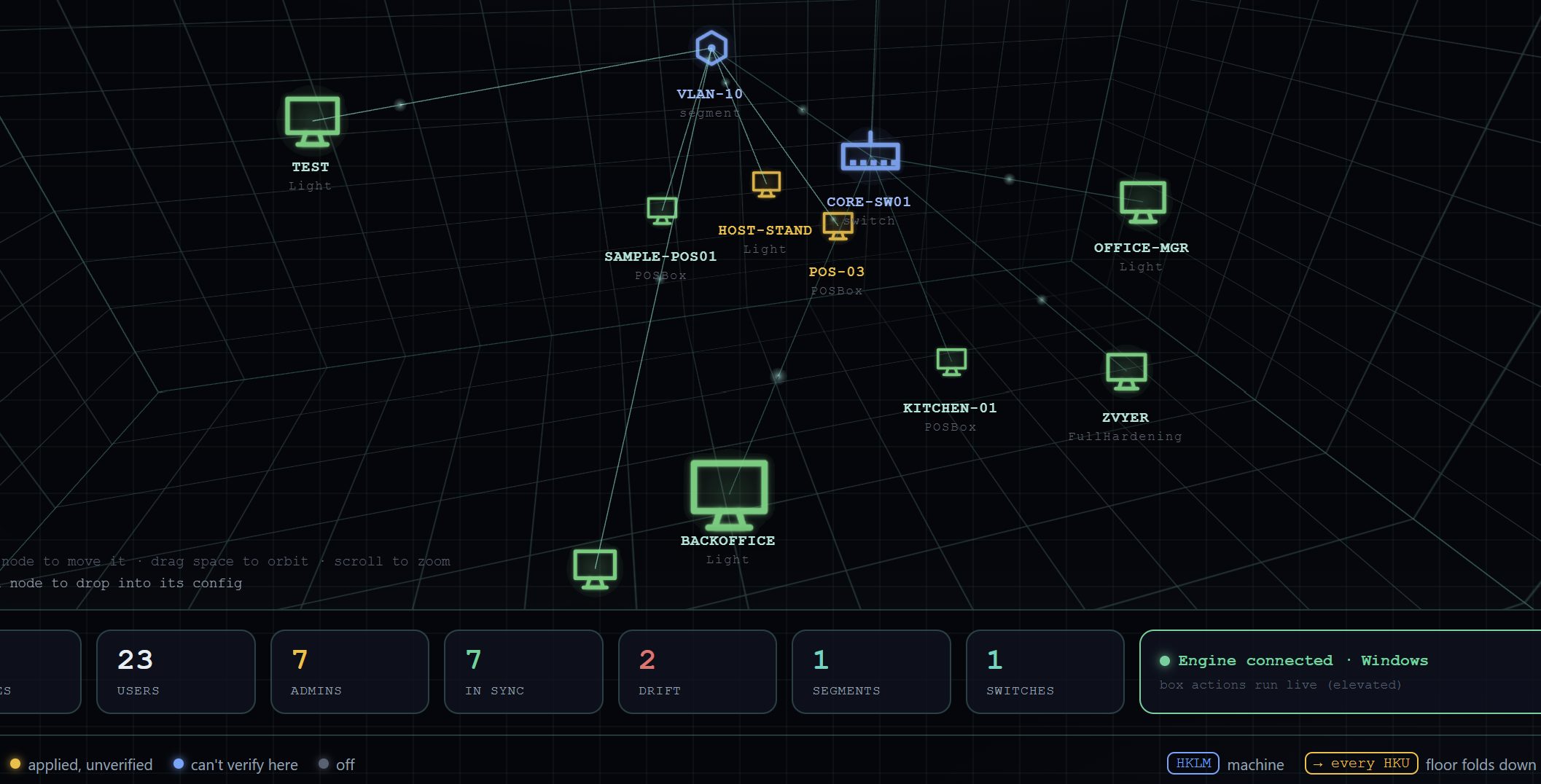
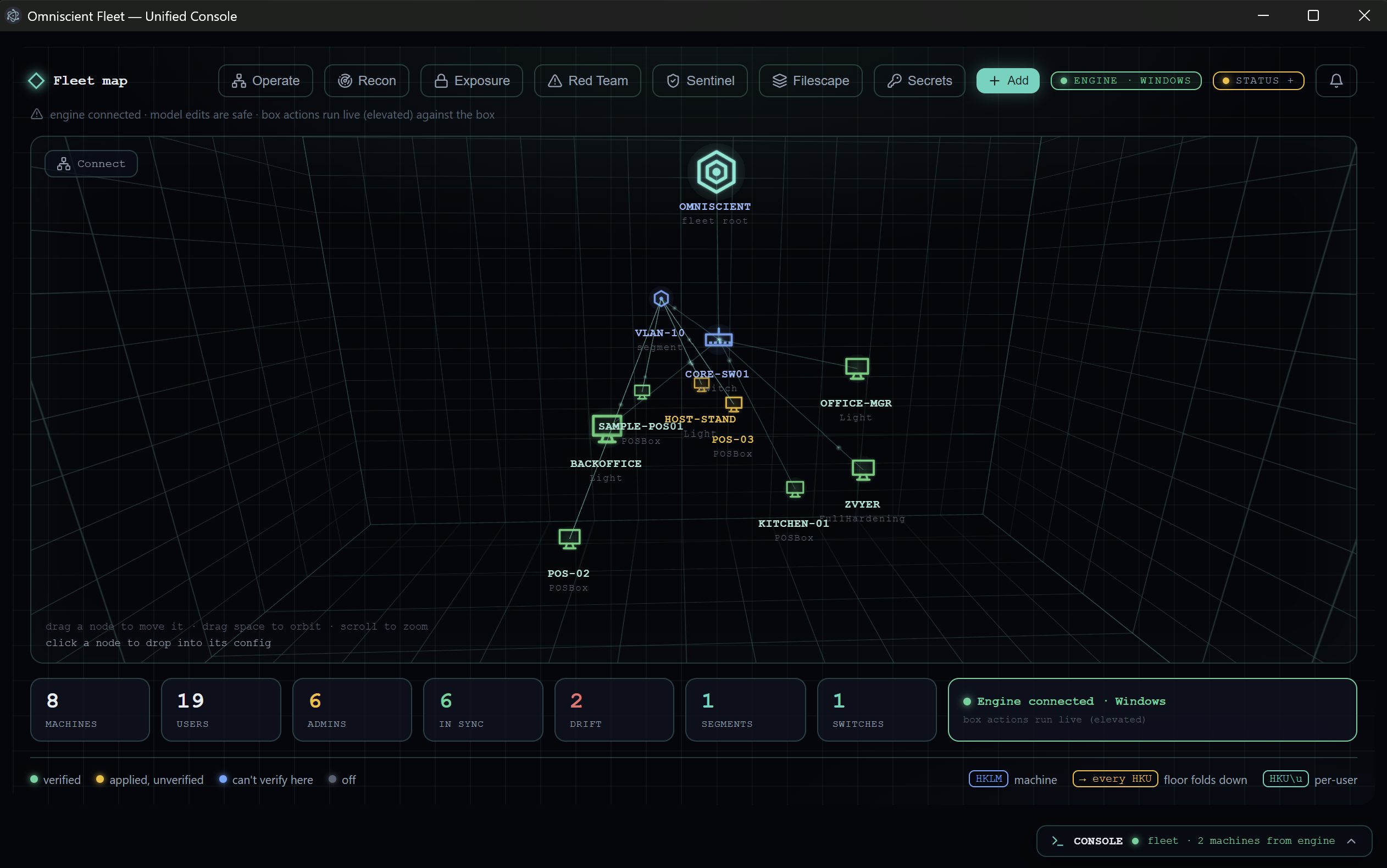
Policy inherits down three levels, each mapping to something an operator already thinks in: National is the network — topology, segments, switches. Federal is the machine — system-wide hardening applied to every account unless overridden. State is the user — role-based policy, because a General Manager's workstation is not a line cook's.
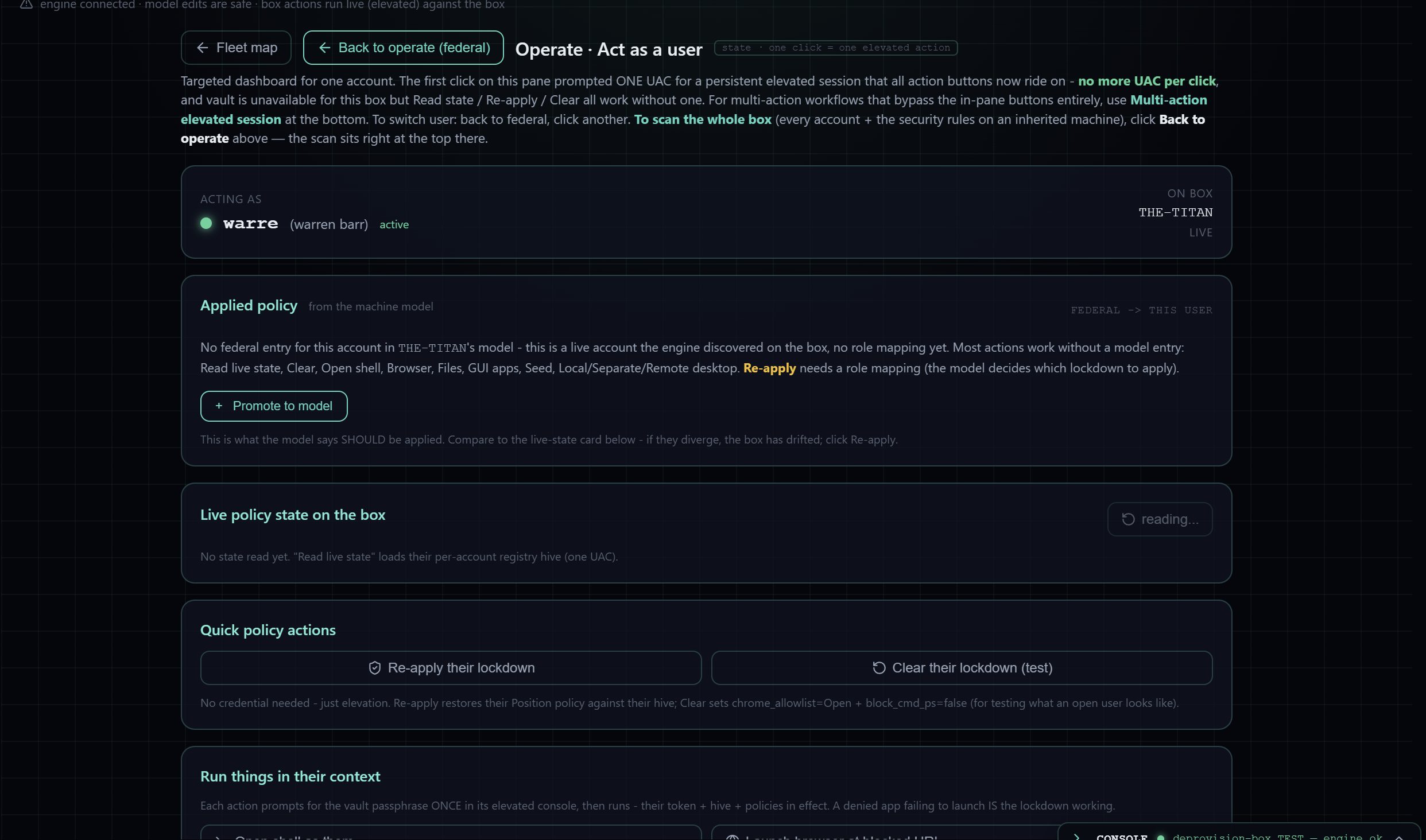
When the engine finds a live account with no role mapping yet, it doesn't pretend the account isn't there — it's surfaced as ungoverned, with a one-click path to promote it into the model. Nothing stays invisible by accident.
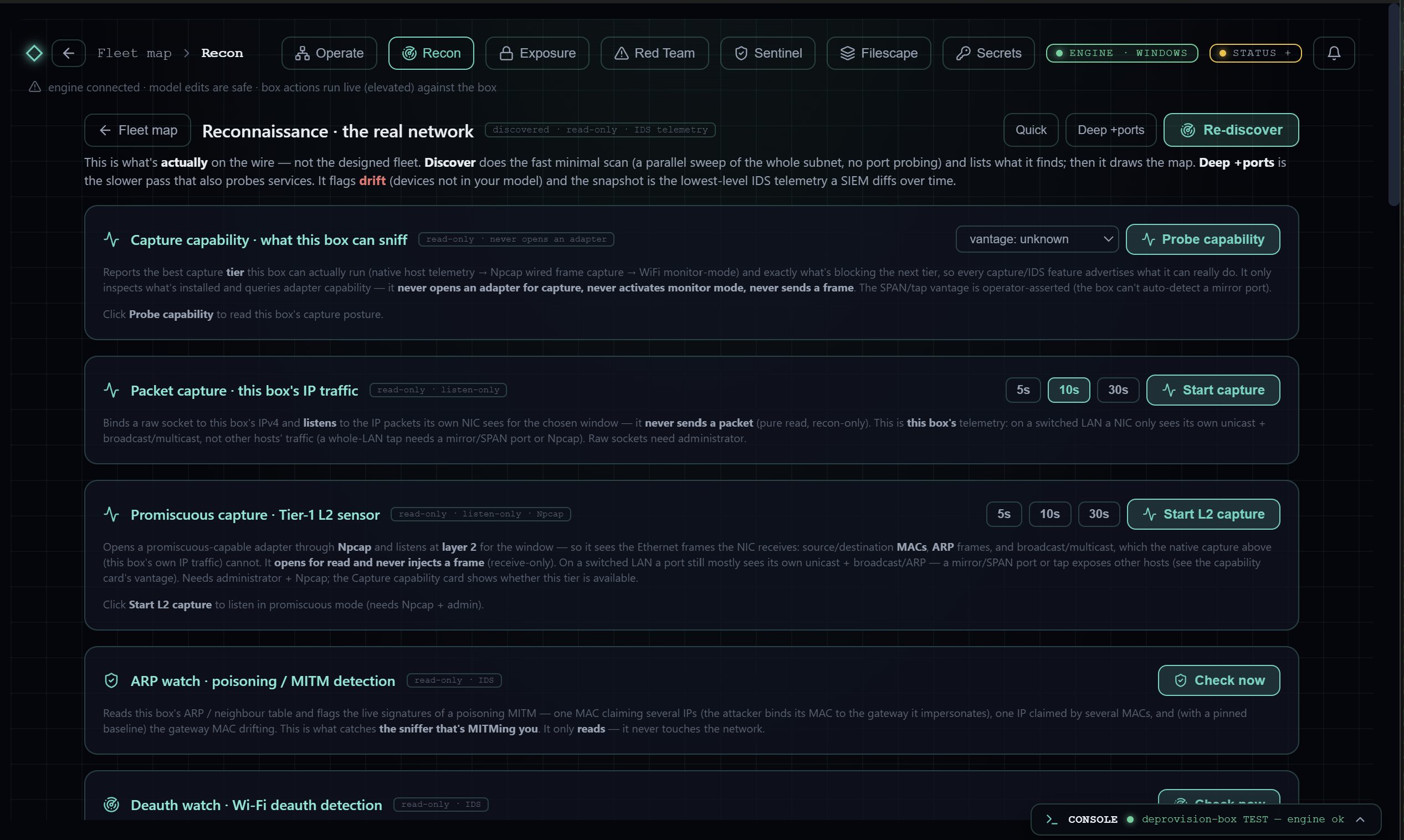
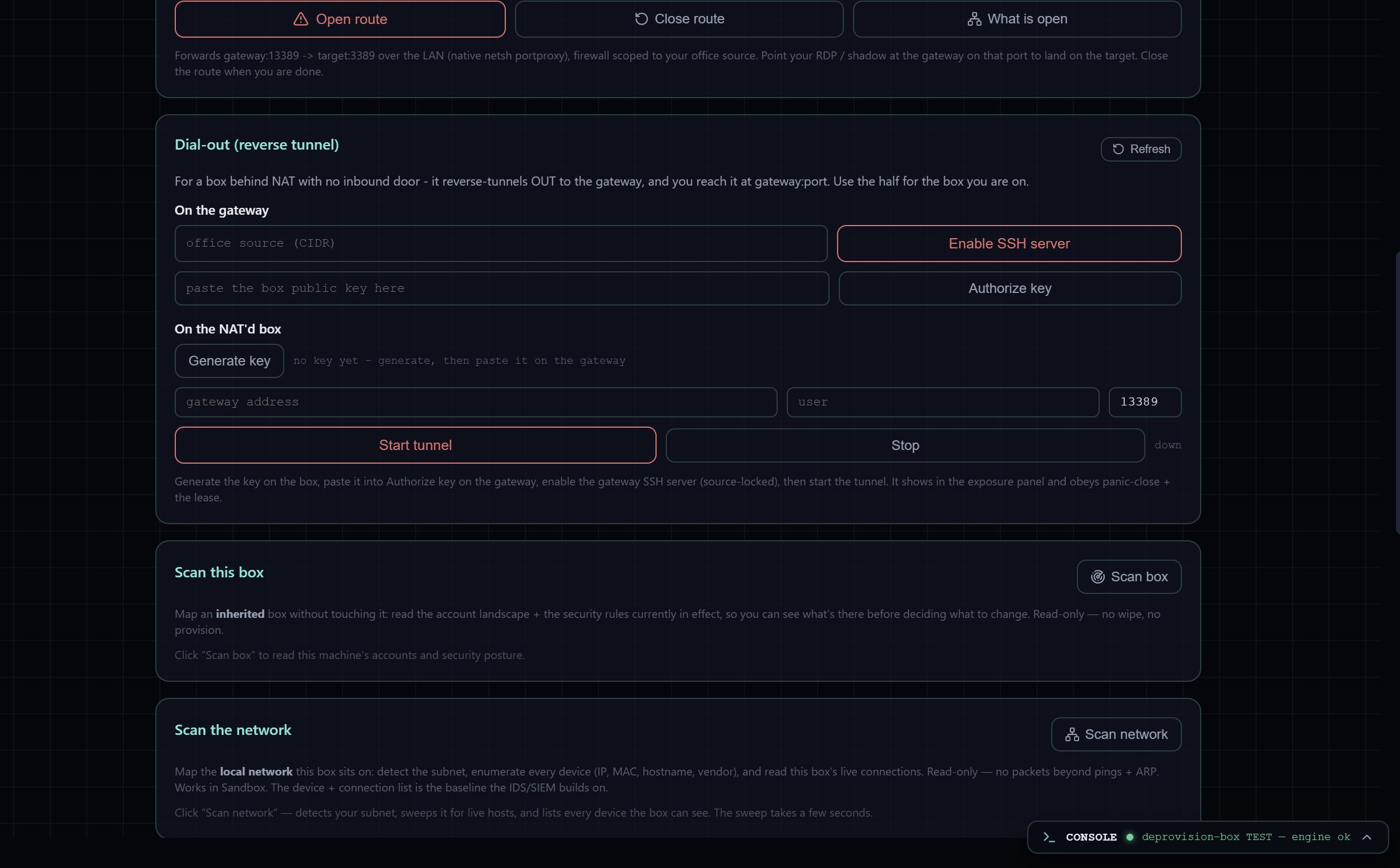
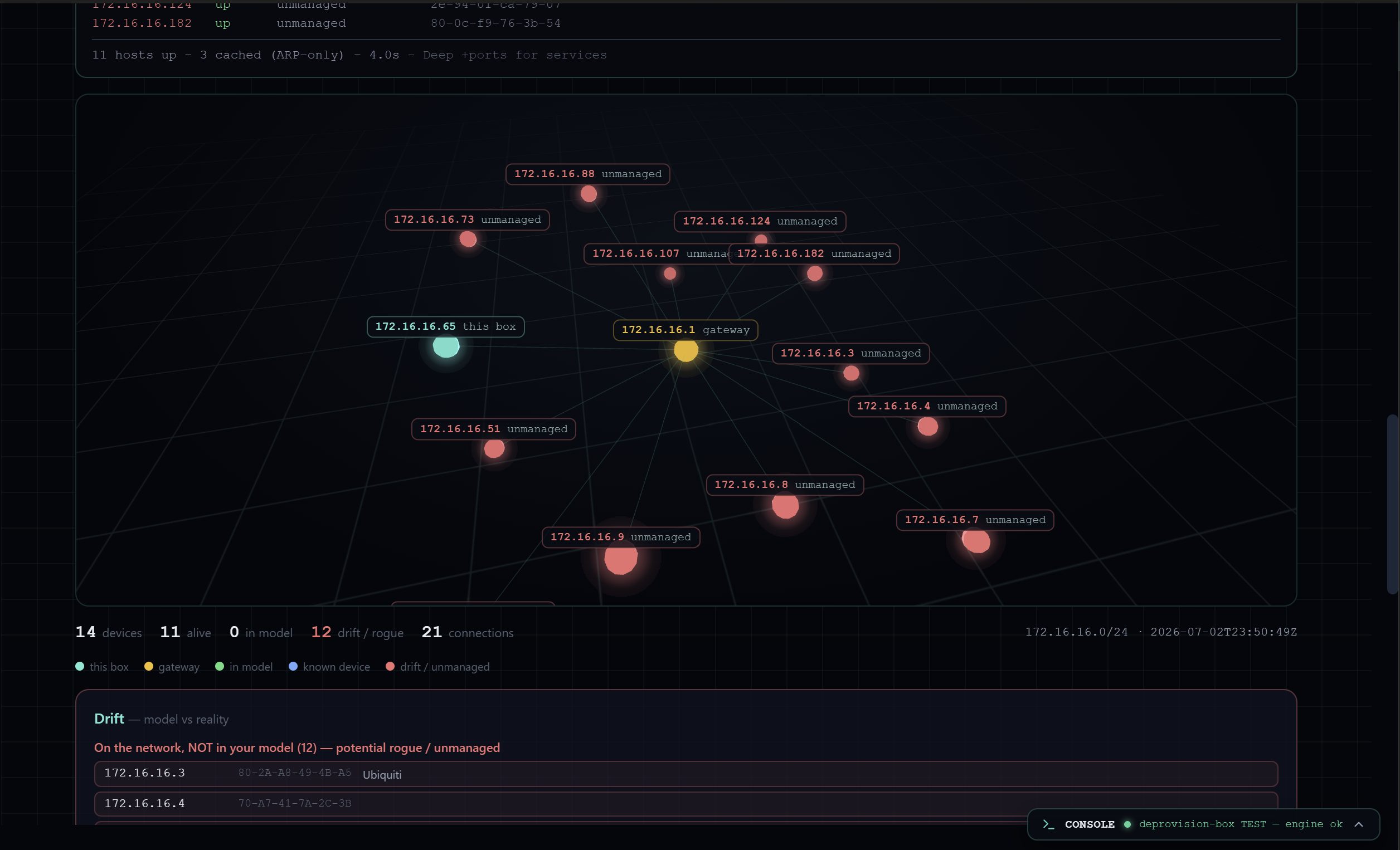
A fast parallel sweep maps the subnet; a deeper pass probes services. Whatever it finds that you didn't put there is surfaced as drift, with real MAC and vendor data — often the single most valuable thing you can show a new client: the devices on their own network that nobody told them about.
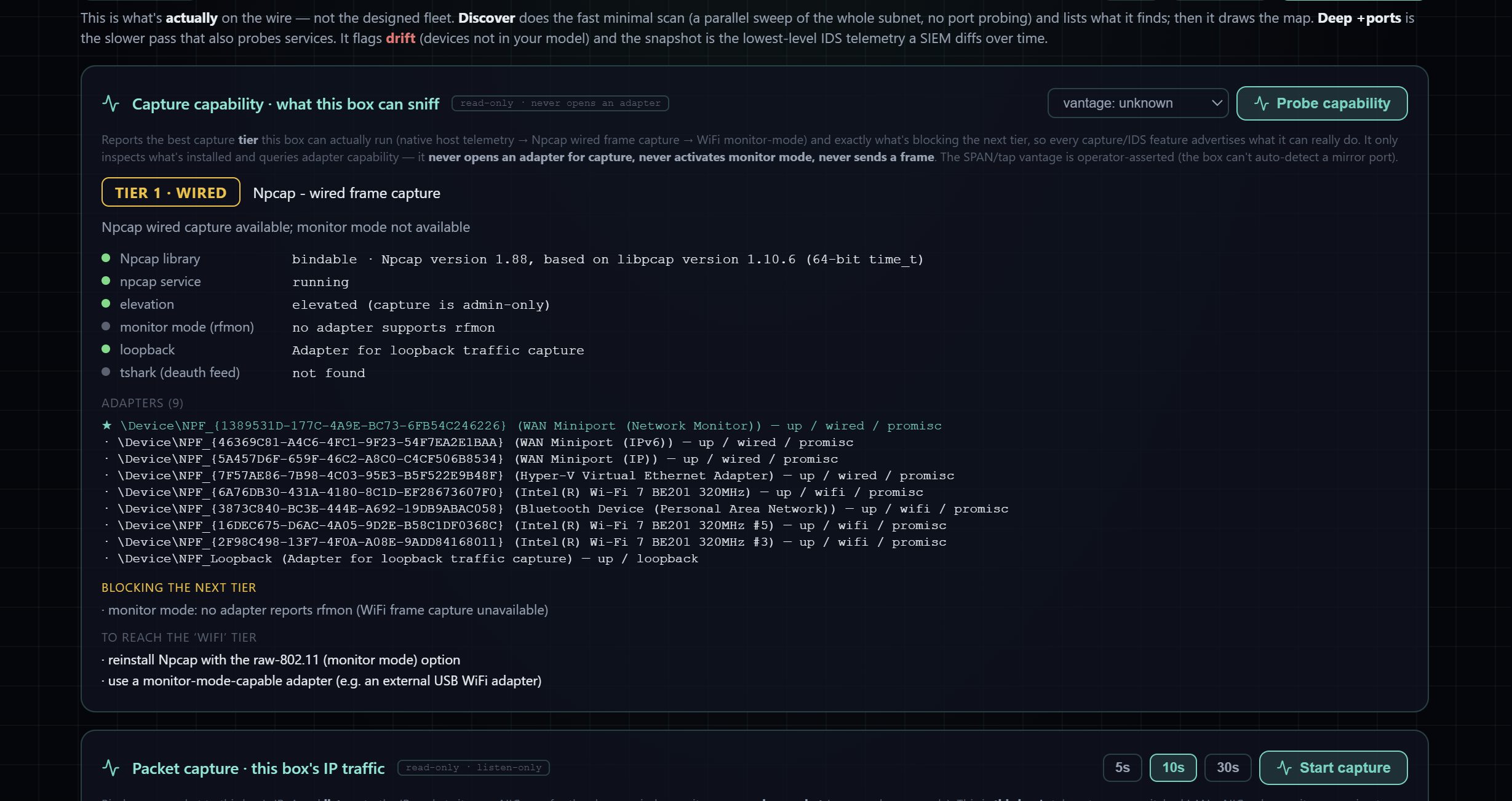
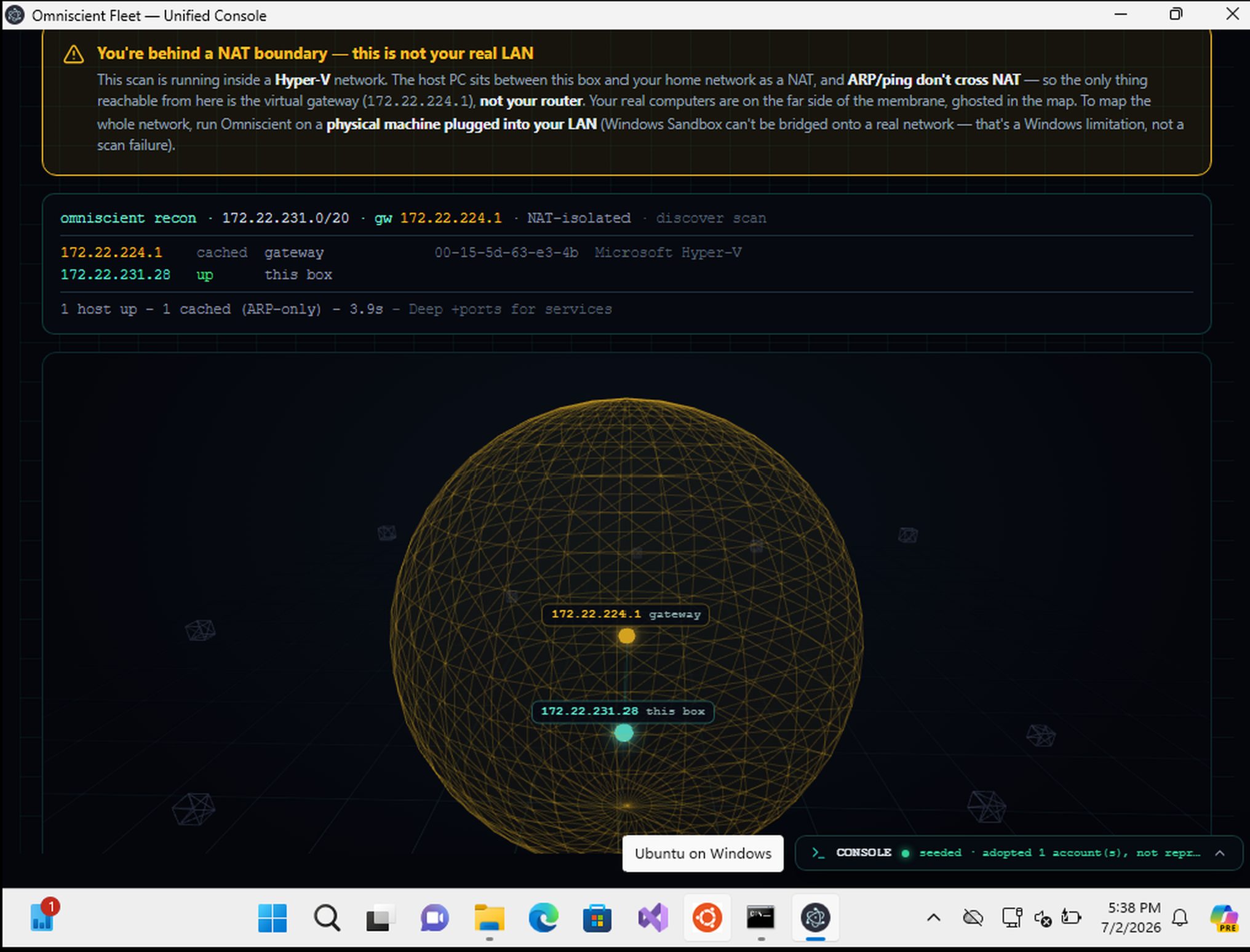
Run recon inside a NAT boundary and the platform detects it, explains the mechanism, and tells the operator how to get a true reading — instead of handing back a falsely clean scan. A tool that tells you when it can't see something is worth more than one that always shows green.
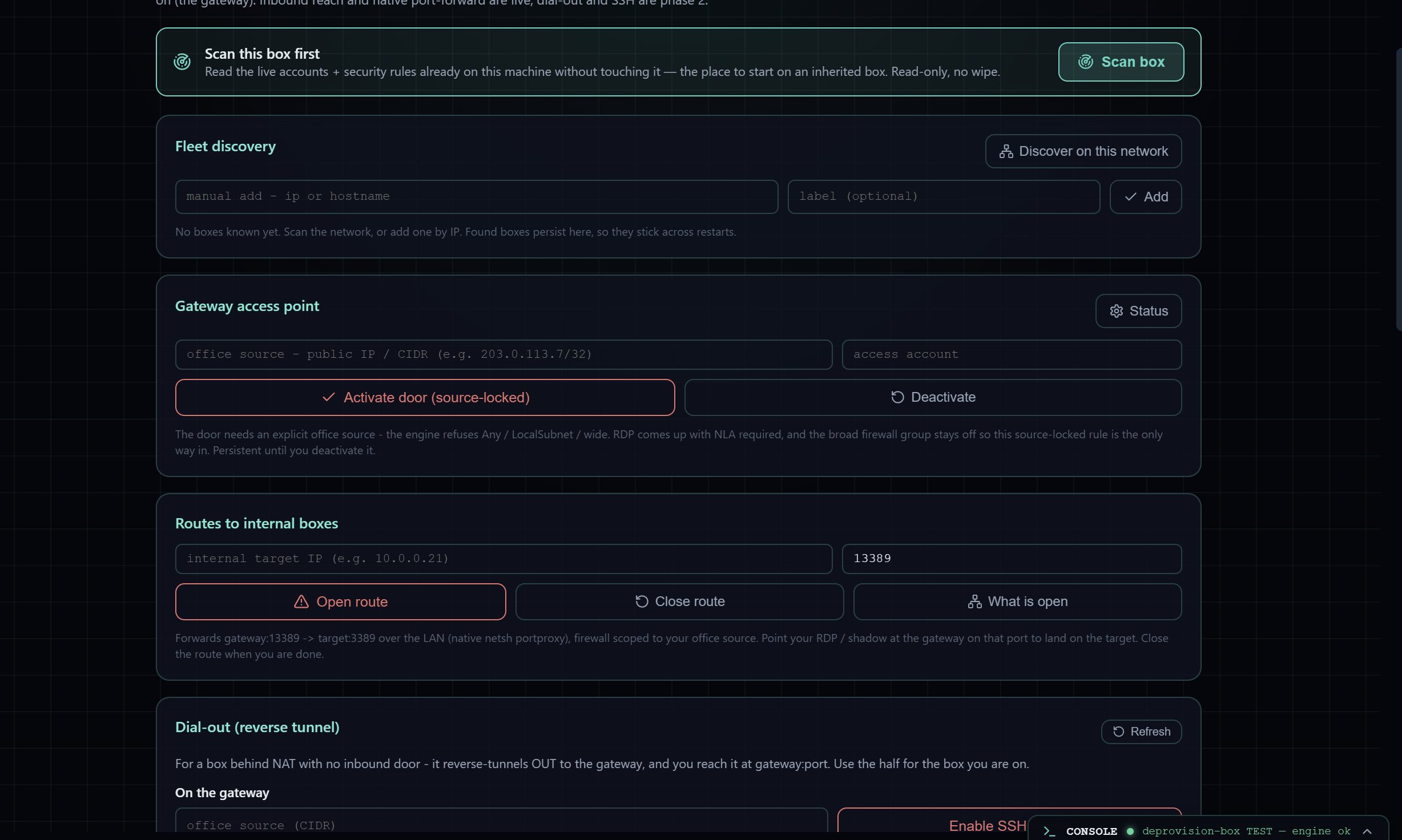
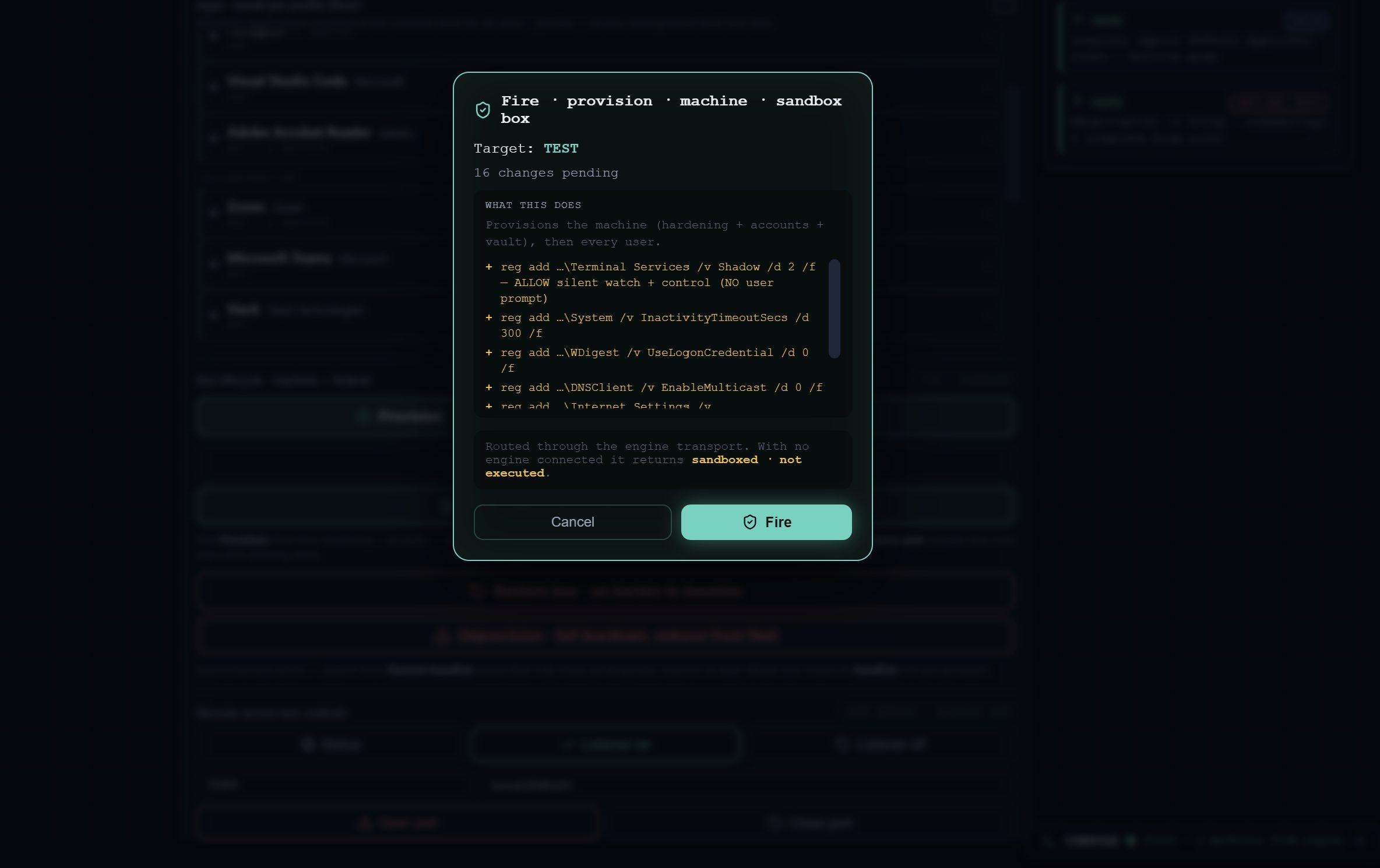
The engine refuses wildcard and LocalSubnet firewall rules outright. Every door is locked to a specific office source, every route is scoped and auditable, and every port forward tears back down to exactly the state it started in.
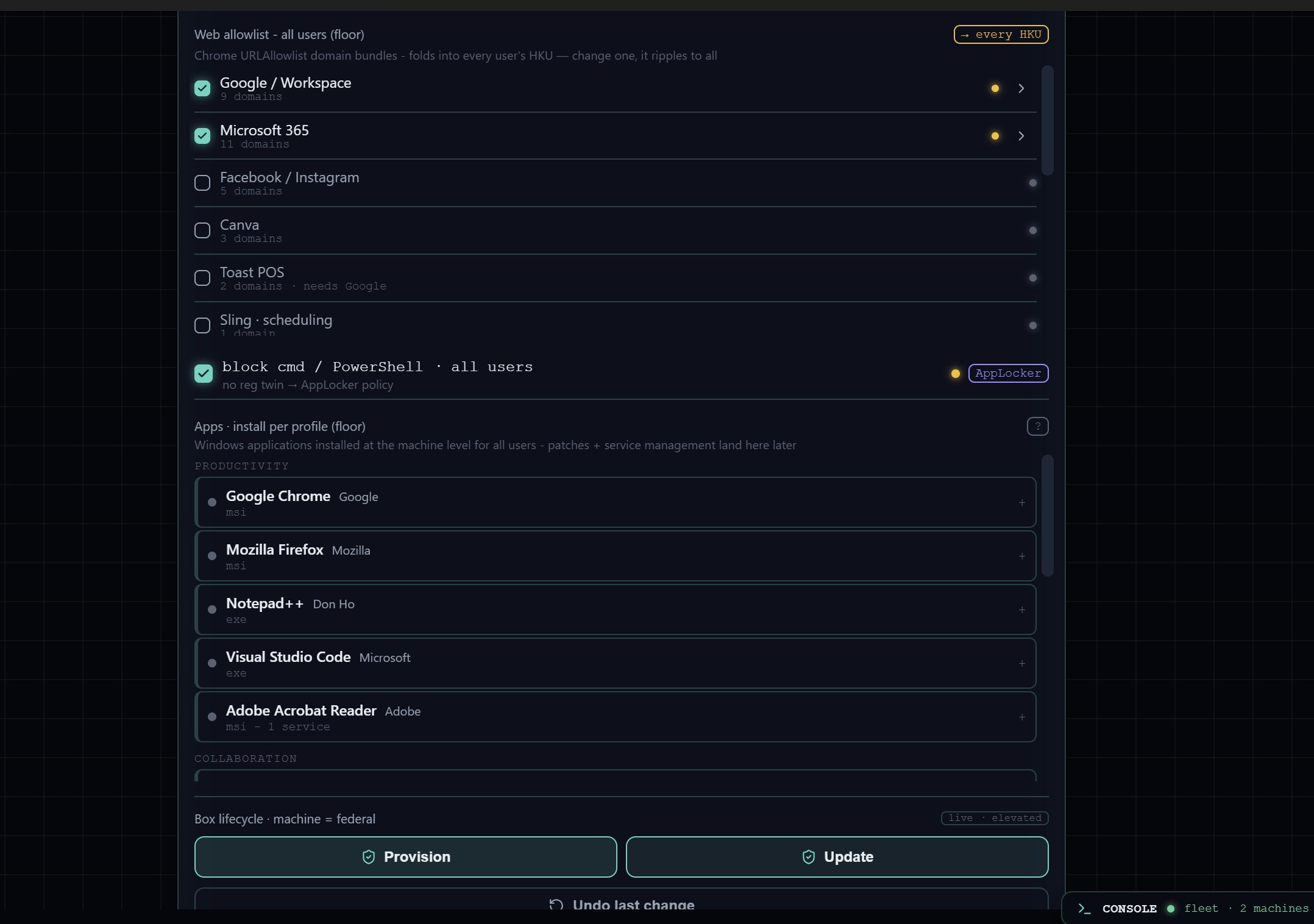
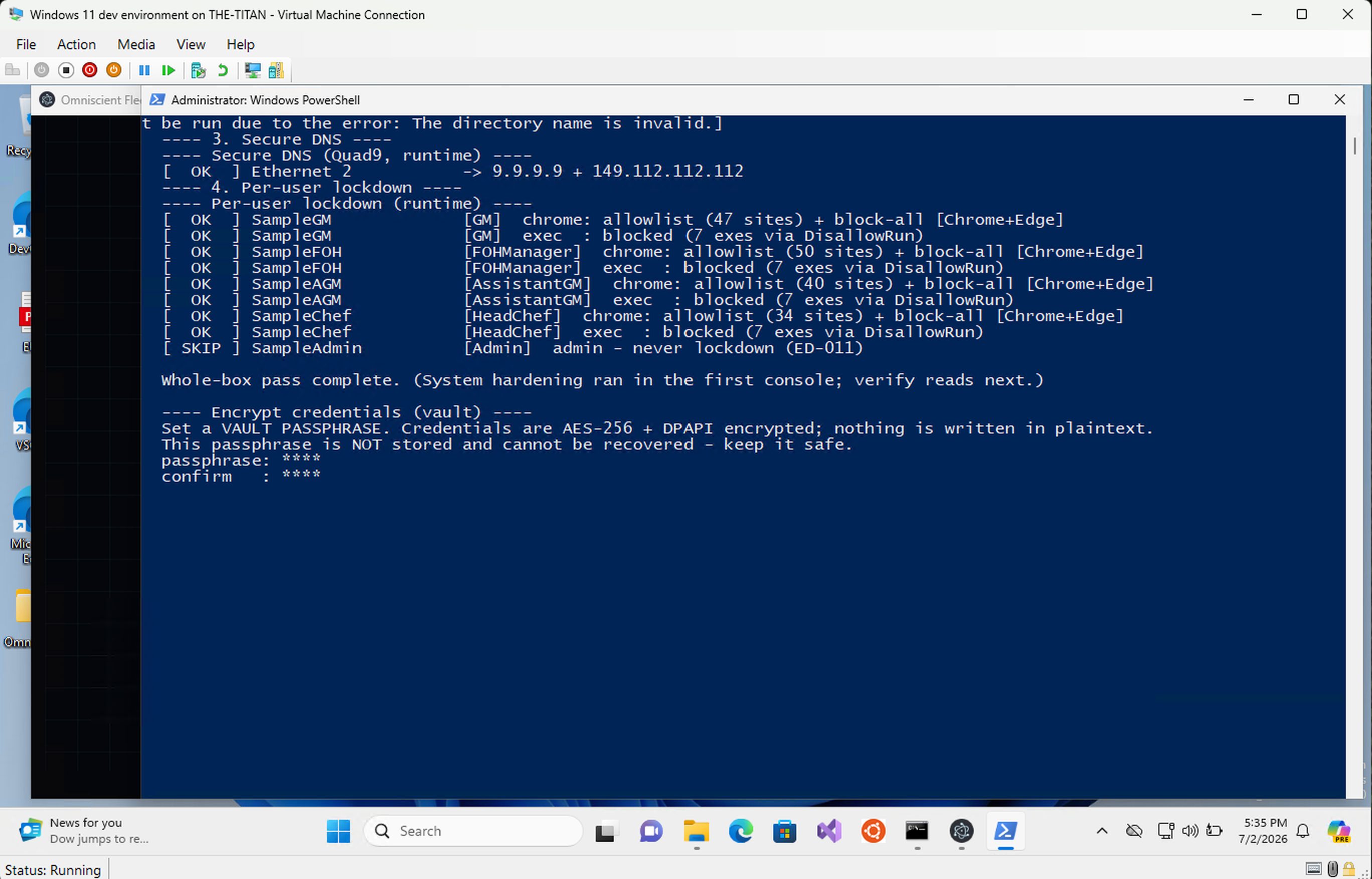
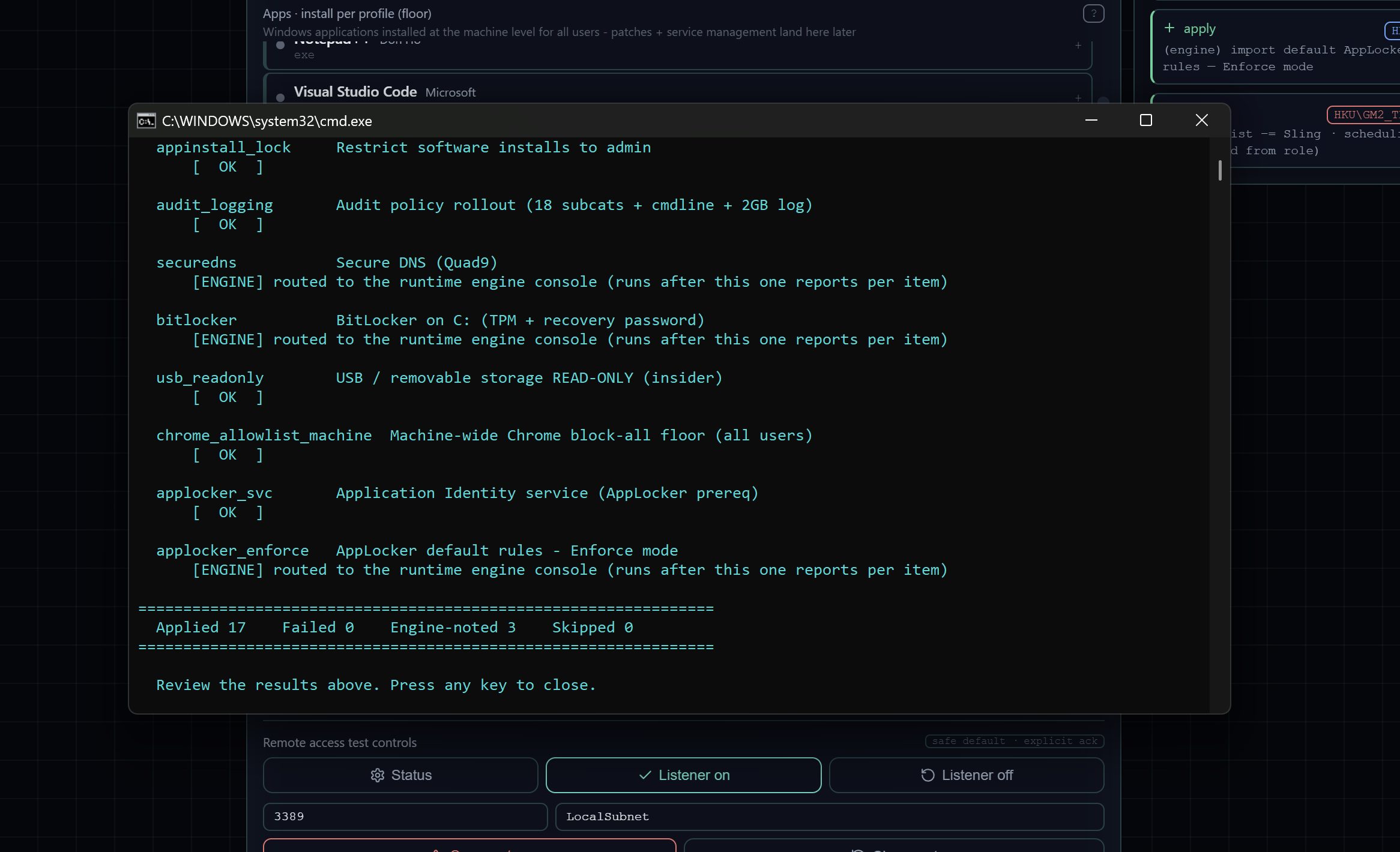
Role-based presets carry sensible starter security for every position, with per-role web allowlists and application control layered on automatically. Admin accounts are structurally exempt from the lockdowns applied to everyone else — by design, not oversight. Every run is atomic and logged, so you can prove exactly what changed.
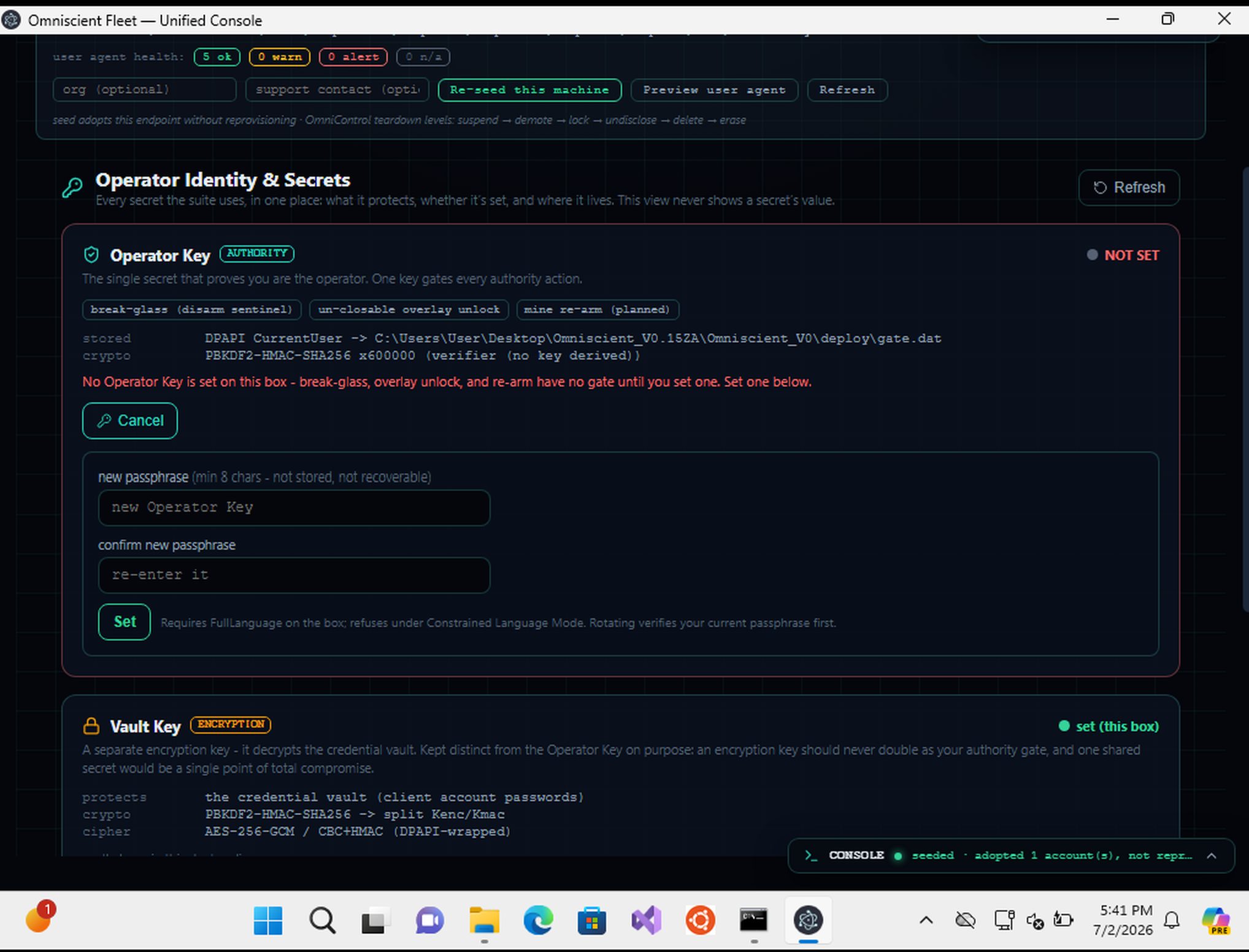
The Operator Key gates authority actions — break-glass, overlay unlock, mine re-arm. PBKDF2-HMAC-SHA256 at 600,000 iterations, verifier-only, DPAPI-wrapped. The Vault Key decrypts the credential vault only, via a separate derivation, AES-256-GCM with CBC+HMAC. Cracking one gets you nothing toward the other.
Passphrases are never stored and cannot be recovered if lost — by design. No hash hard-coded in source, no bare fast hash, no plaintext fallback anywhere; each of those failure modes is explicitly forbidden in the platform's own engineering standard.
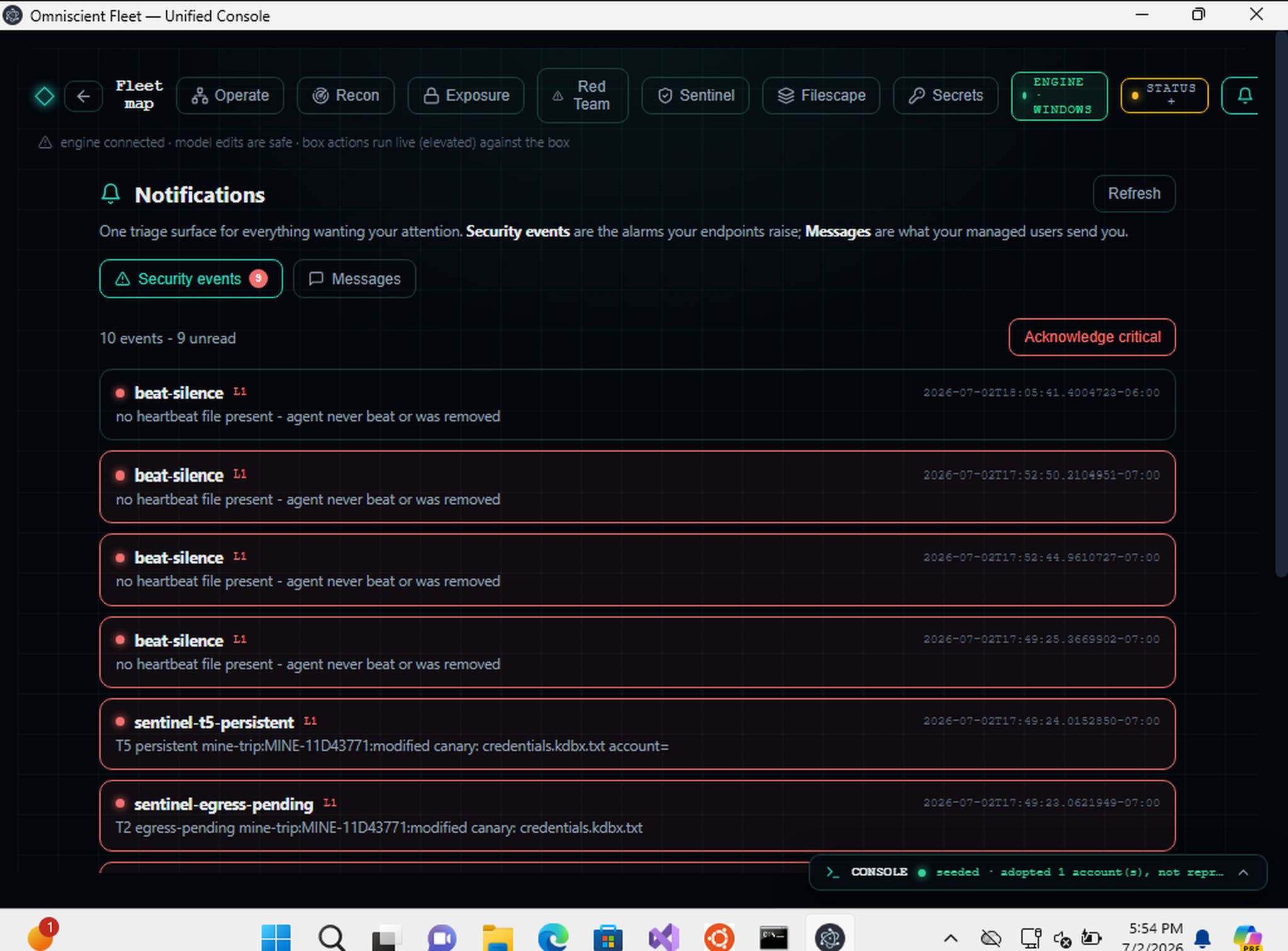
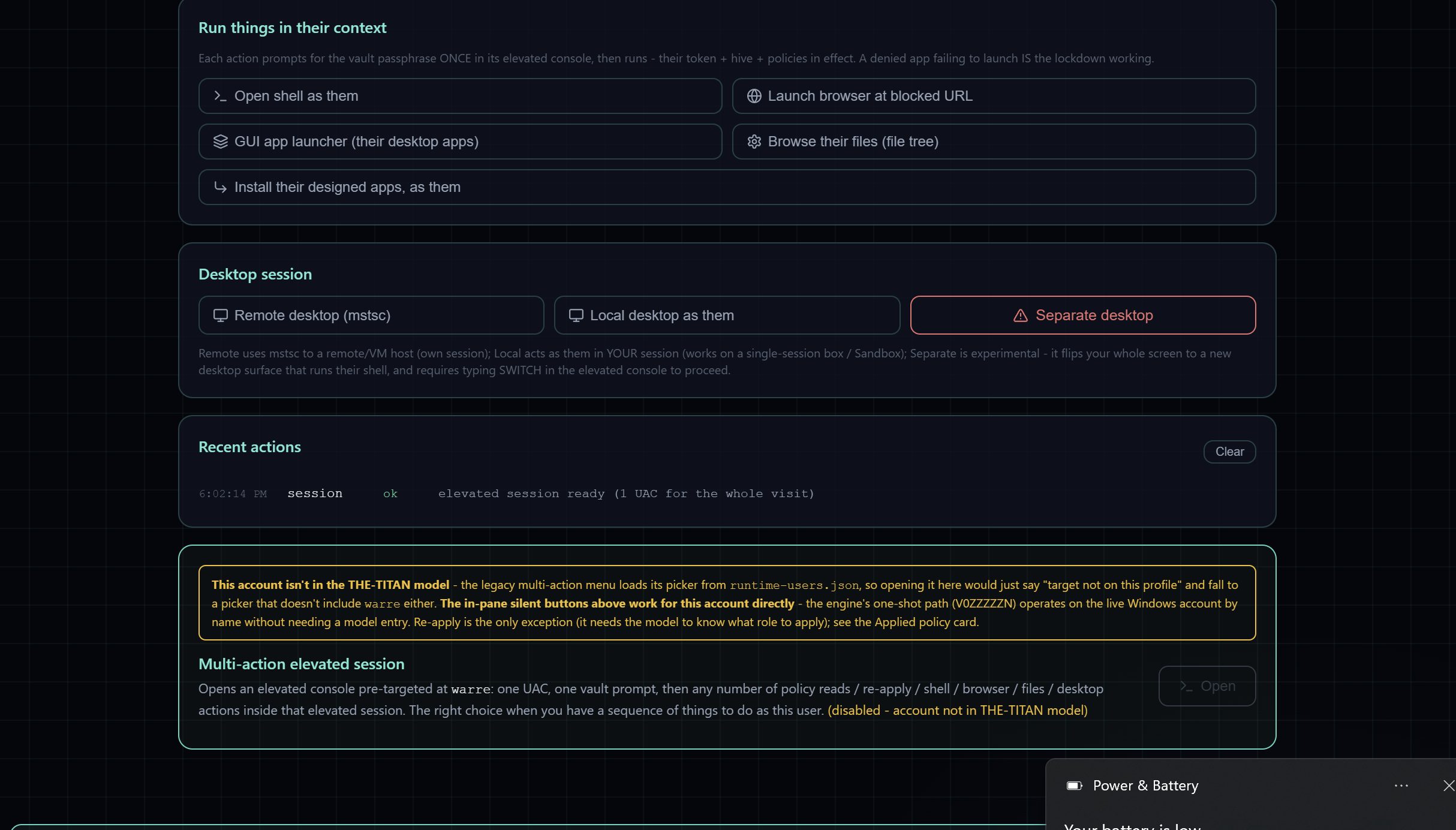
Acting as a specific user is a single elevation, not a UAC prompt on every click — one authorization covers the whole visit, logged as one session. Live policy state is read straight off the box and compared against the model; divergence surfaces as drift. Nothing forces the operator to hunt box-by-box: the whole fleet's alarms and messages land in one triage feed.
Think about an intruder's cost. Today, once they're inside, their only real cost is time. They move laterally and explore at leisure, because nothing punishes movement. Omniscient inverts that. Every step an attacker takes through a protected environment raises their odds of triggering an automated, recorded containment event. You aren't just detecting them — you're making the environment too expensive to navigate.
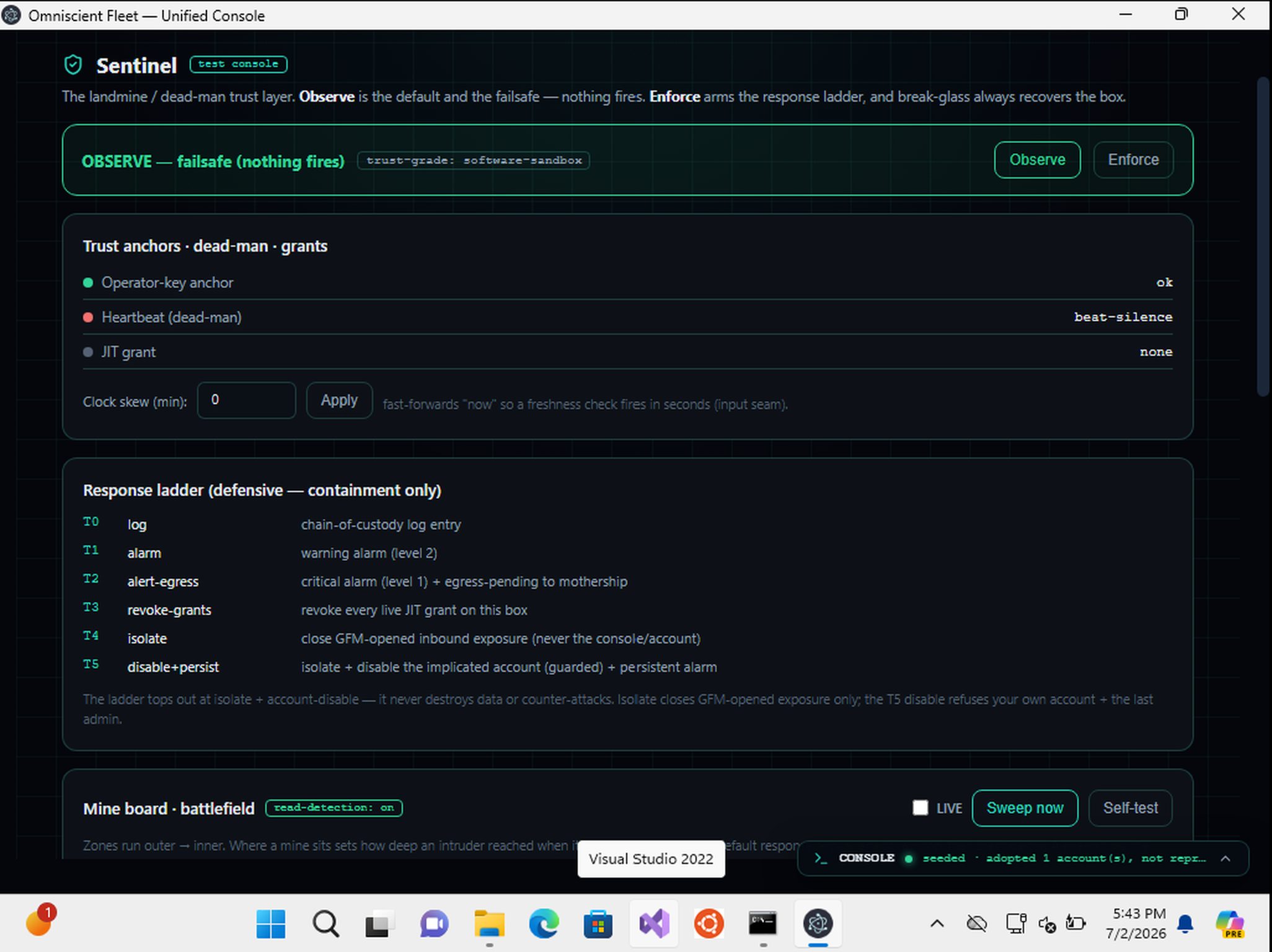
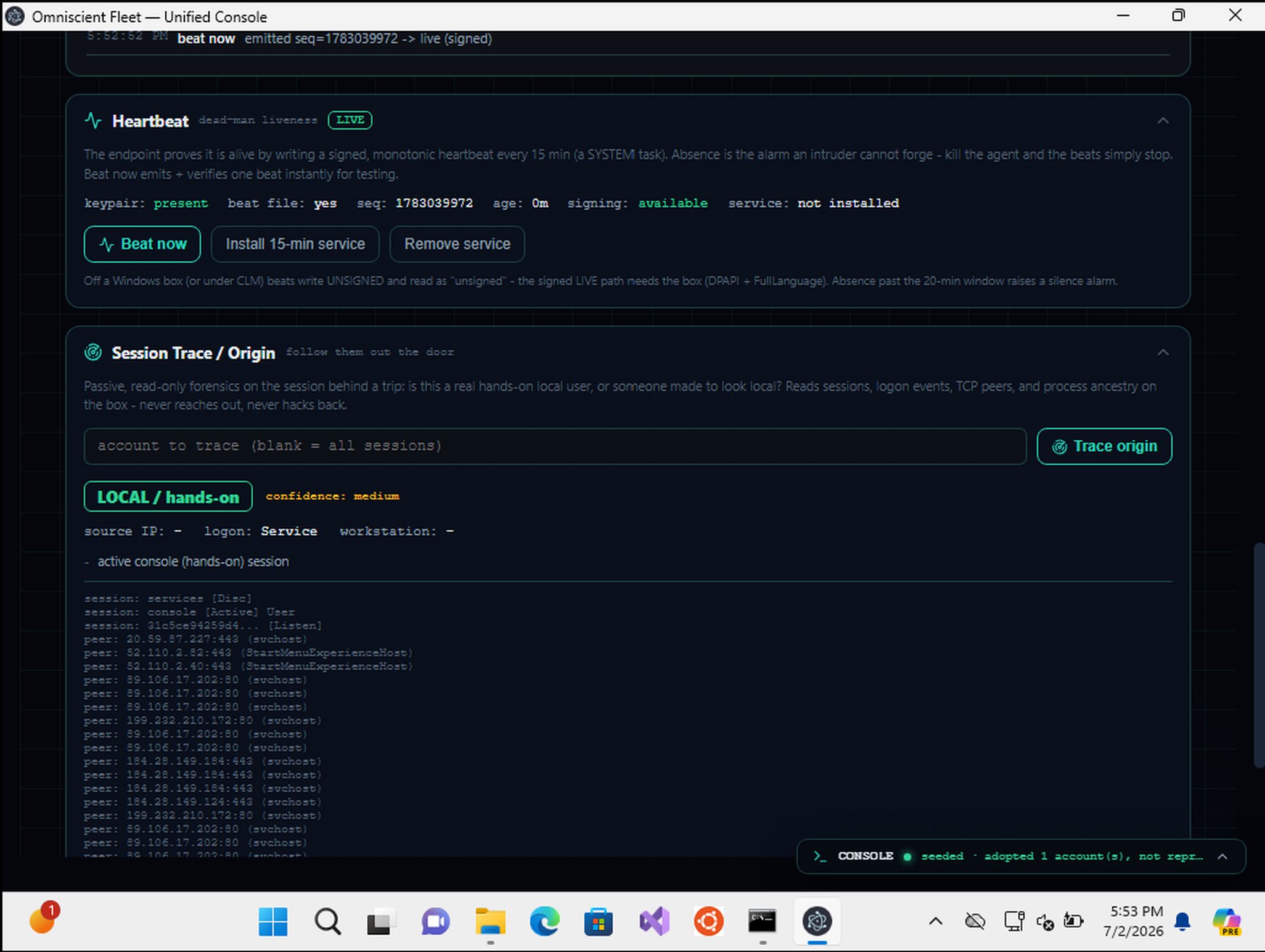
Every endpoint writes a signed, sequenced heartbeat on a fixed interval. The clever part isn't the beat — it's what its absence means. An intruder can kill the agent, but they cannot forge the next beat; there is no signing key on the box to steal. Silence isn't a gap in coverage. Silence is the alarm — the one signal an attacker can't fake their way around.
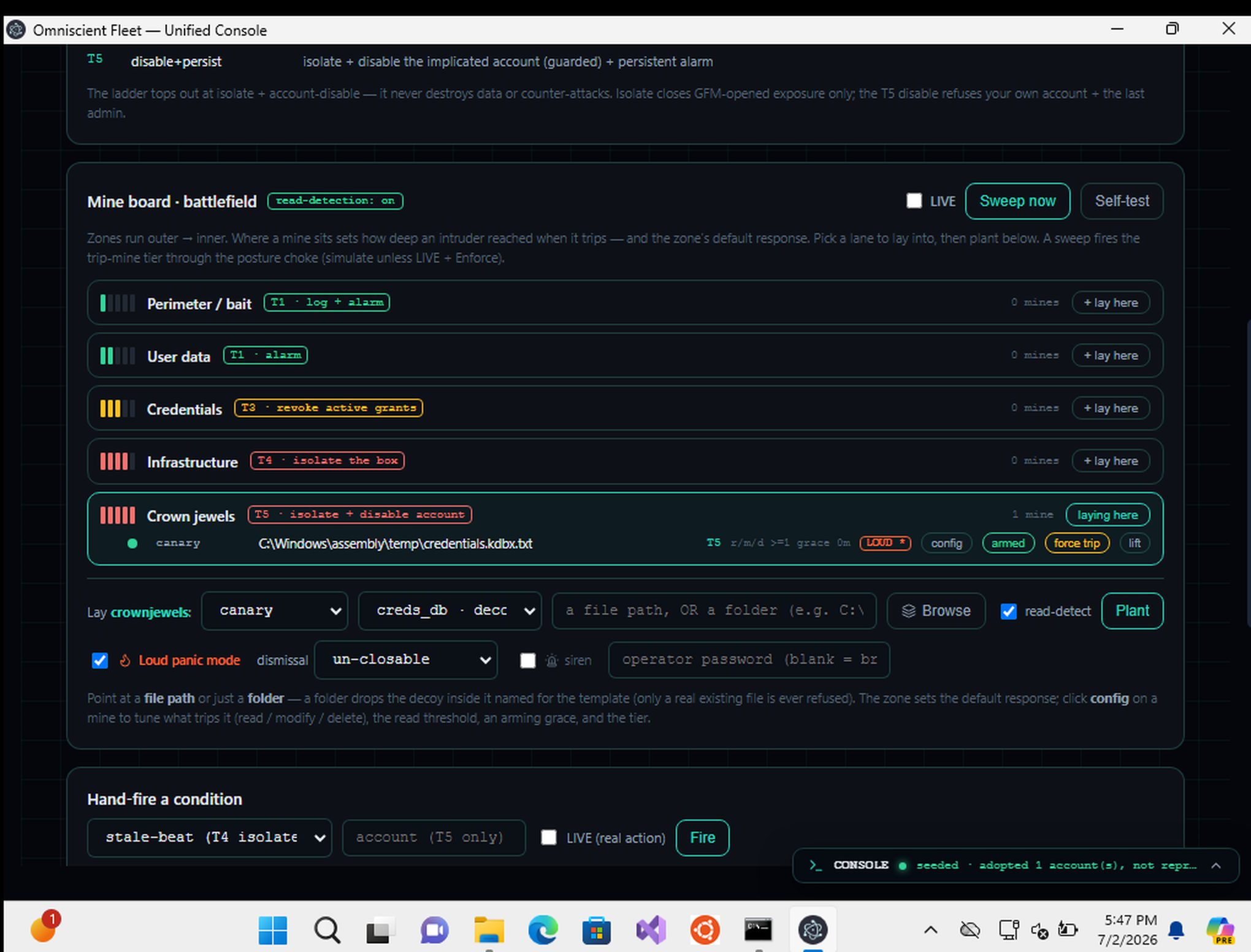
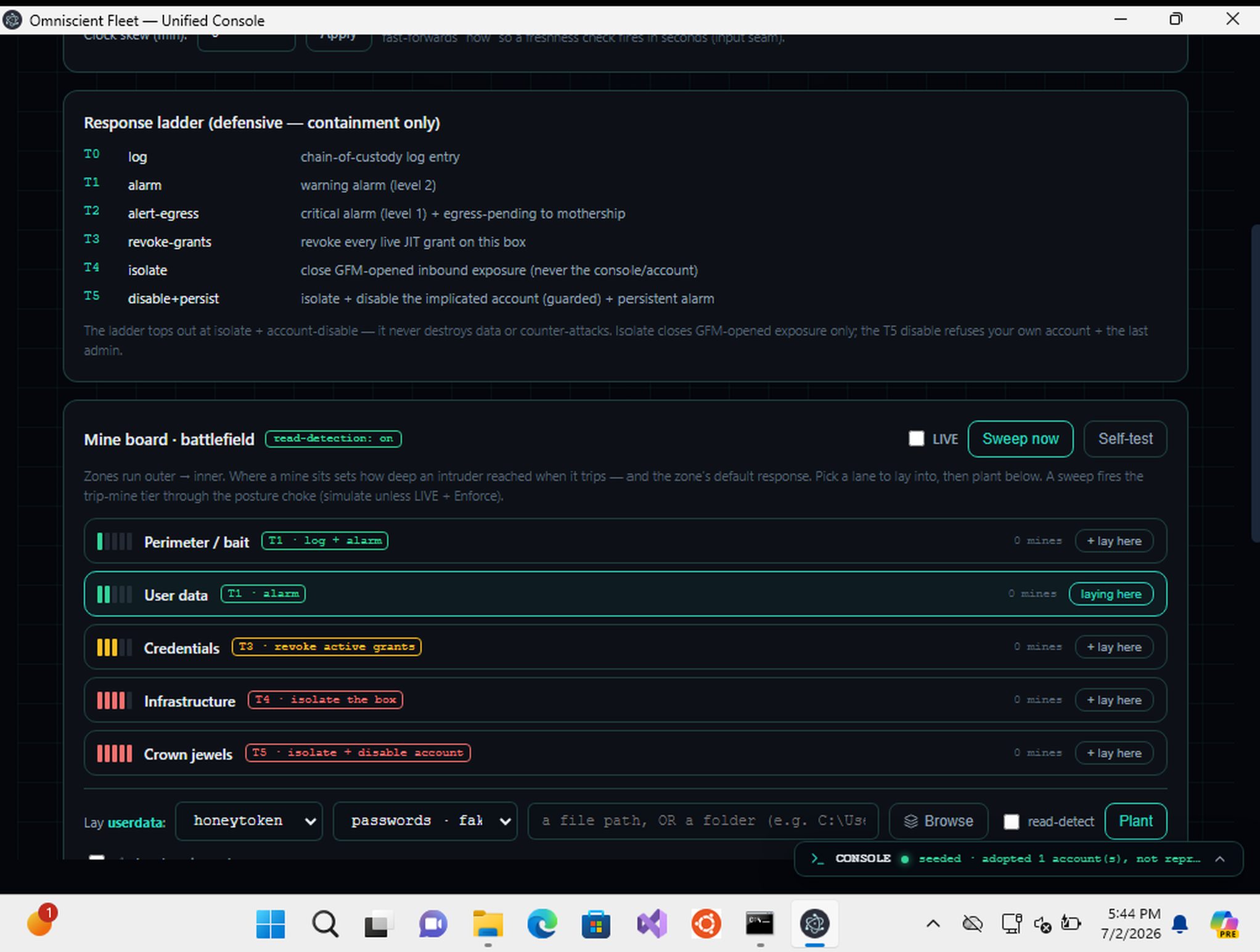
Touch a decoy and a response fires automatically. But it isn't one blunt action — it's a ladder, and where the decoy sat decides how hard the system hits back.
| T0 | Log | Chain-of-custody entry. Always, no exceptions. |
| T1 | Alarm | Warning-level alert the instant the decoy is touched. |
| T2 | Escalate | Critical alarm, flagged for off-box escalation. |
| T3 | Revoke | Every live just-in-time access grant on the box is pulled immediately. |
| T4 | Isolate | Closes the exposure the platform itself opened — never the operator's console, never the account. |
| T5 | Disable | Isolates and disables the implicated account — but never the operator's own, and never the last admin. |
Notice what the ladder doesn't do. It never destroys data. It never counter-attacks. Its most aggressive rung refuses to lock out the last way back in. That restraint is deliberate: this runs unattended on a client's production box, so its worst-case action has to be one you'd still be comfortable with at 3 a.m. Containment, not vengeance.
Yes. The ladder ships pre-configured for safety, but every rung is configurable to match each client's risk appetite. A cautious client can cap the response low; a high-security client can arm the full ladder. Same platform, tuned per engagement.
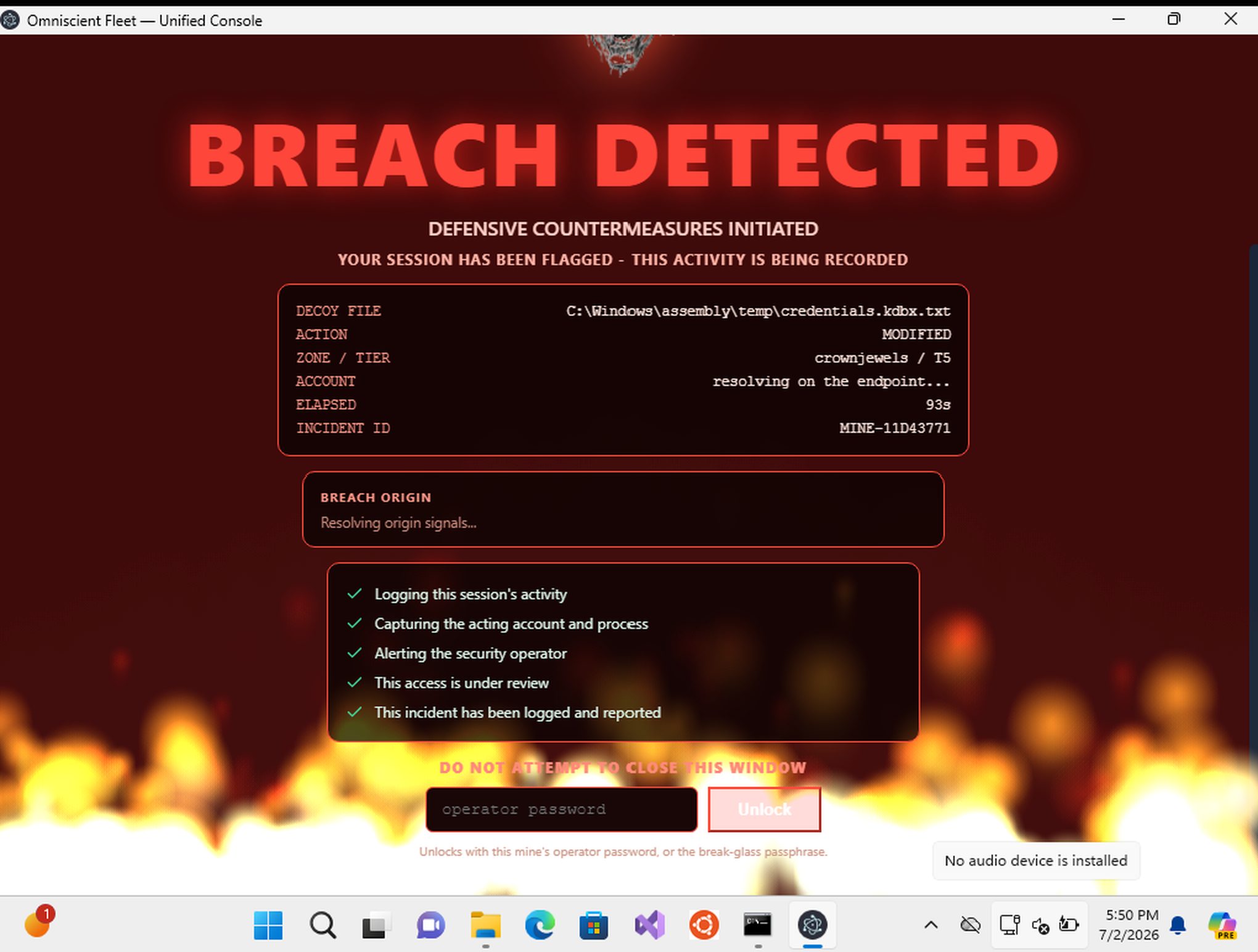
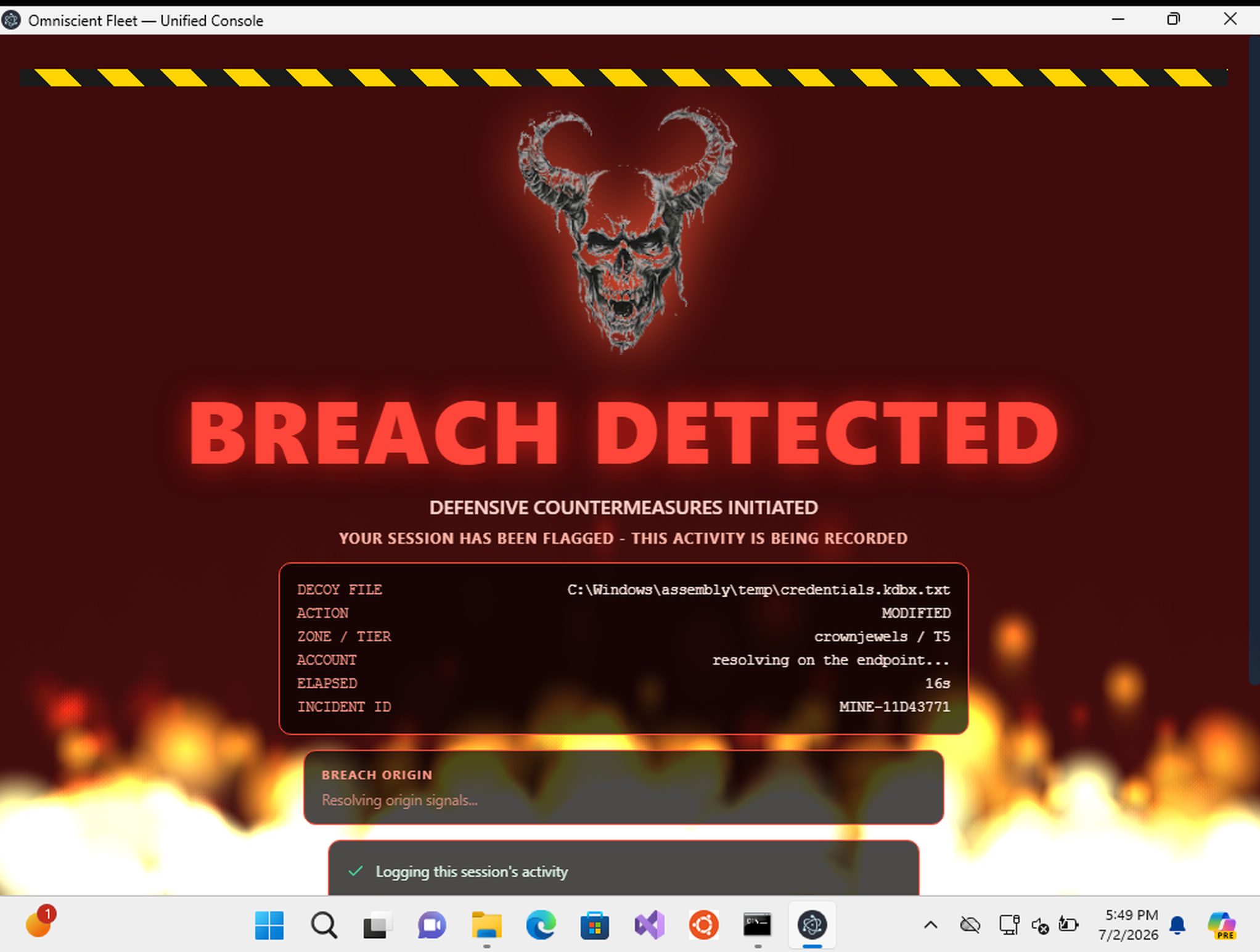
When a loud mine trips, the response isn't only technical. The intruder's own session is taken over and told, in the most unambiguous terms the screen can manage, that they've been caught and the response has already started. You break the attacker's momentum by showing them, mid-move, that they're inside a trap that's already closing.
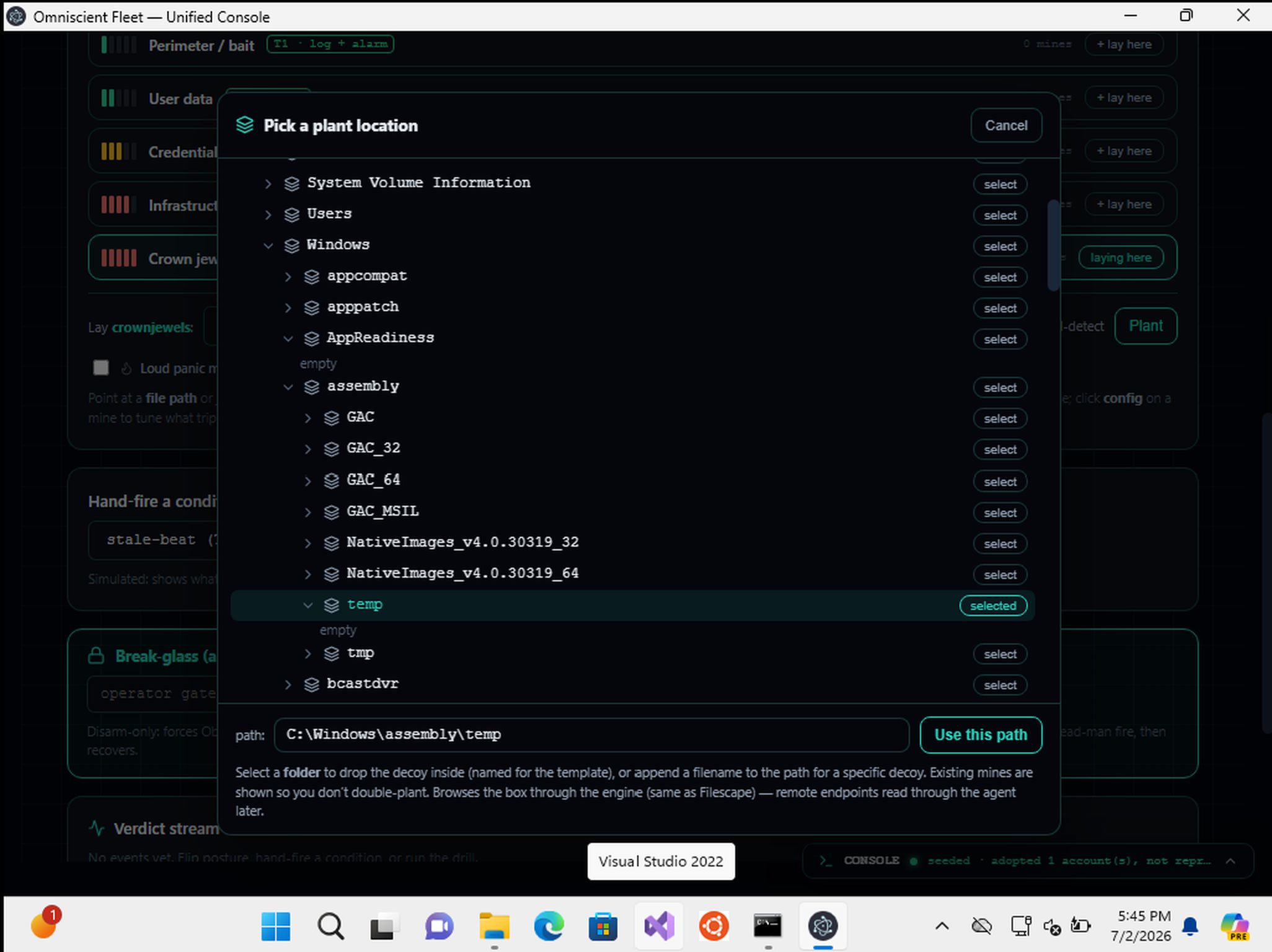
A decoy credential file in the crown-jewels zone is modified. No analyst is watching. The engine acts on its own: the incident is logged with a tracked ID, the acting account and process captured, grants revoked, the session contained, the alarm written to the feed. By the time an operator next opens the console, the intrusion is already contained and fully documented — no 3 a.m. phone call required.
Against a fully-hardened, Sentinel-armed environment, a remote attacker doesn't get to fight the cryptography — they get pushed off it entirely:
So the attacker is forced off the math and onto the two most expensive problems in security: defeating a disciplined operator, and moving through a monitored environment without tripping anything. That's not impossible — nothing is — but it is slow, loud, and expensive, which is the entire point. You have changed the economics.
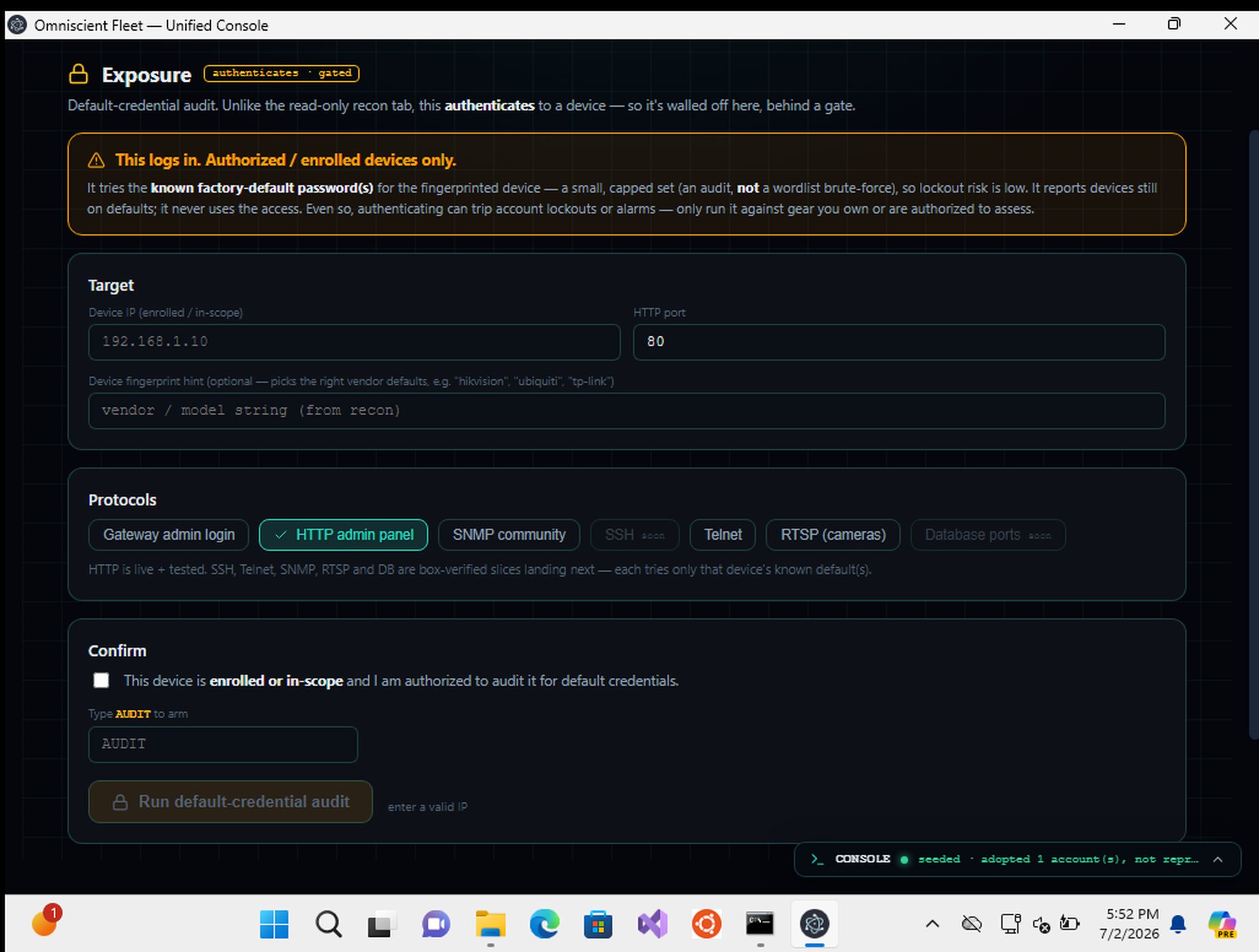
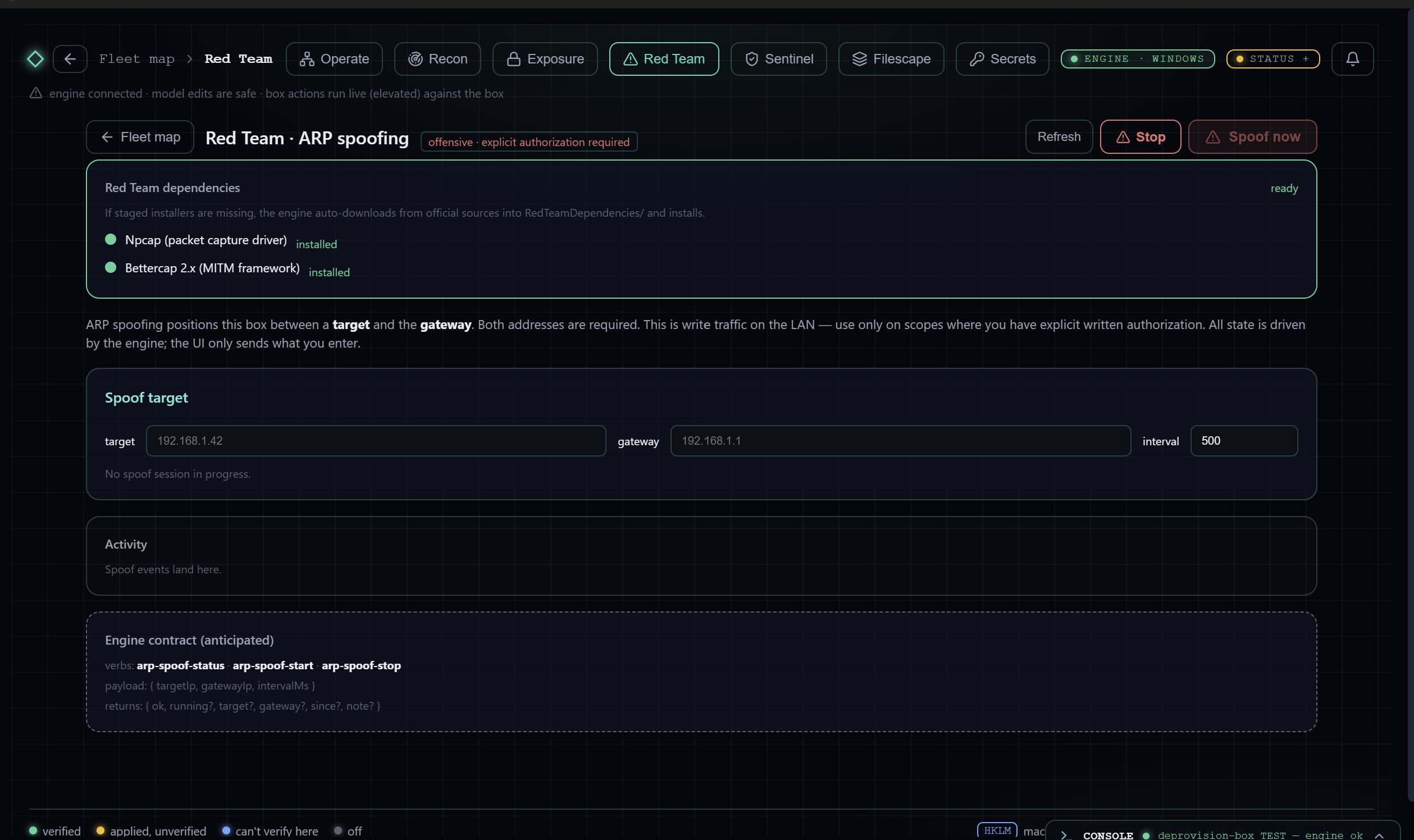
Omniscient ships with its own red-team capability, wired to the same engine as everything else, and enrollment is structured as a continuation program rather than a project with an end date. Under signed rules of engagement and explicit written authorization — enforced in the platform, not just promised in a contract — the exact hardening deployed is tested against, and every finding feeds the next pass.
For a reseller, the continuation program is what turns a one-time sale into recurring revenue: the client's posture doesn't get set once and left to drift — it gets tested, tuned, and re-tested on a standing cadence, under your name, for the life of the contract.
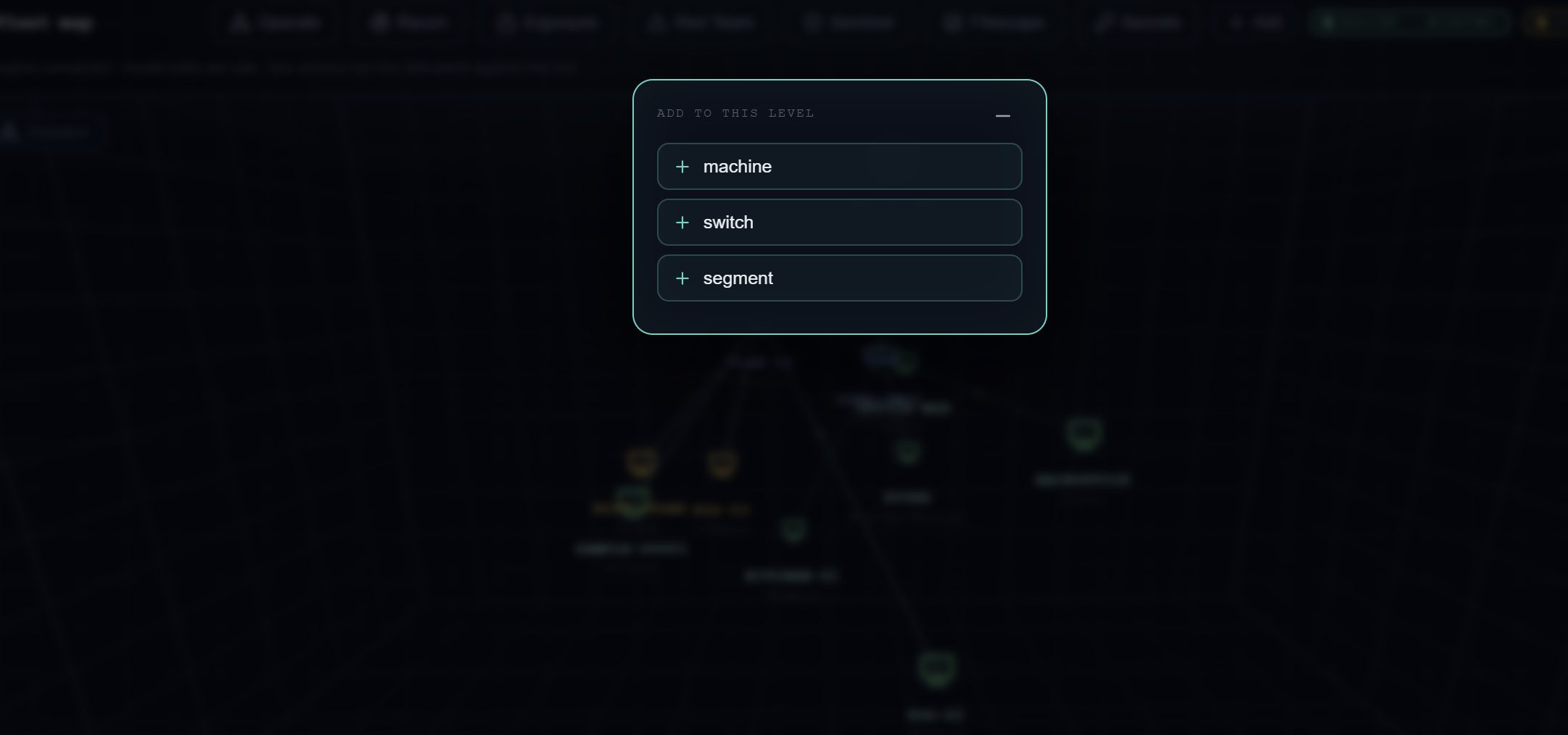
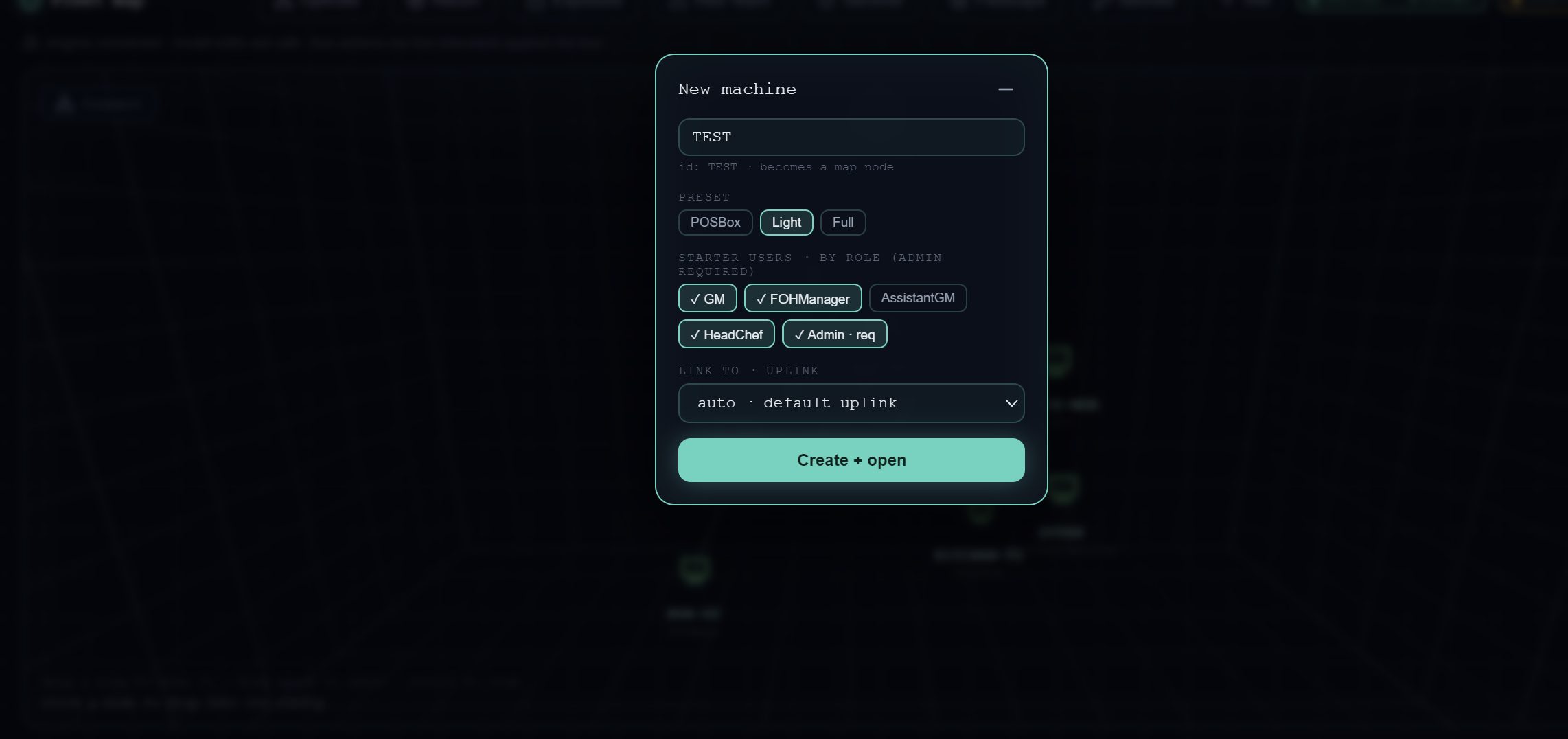
Adding a machine is adding a profile. Adding a client is adding a set of profiles — not re-architecting anything. Role templates fold down to every user automatically, presets carry the hardening baseline, and the same engine drives one endpoint or a thousand. The operator's console doesn't change as the fleet grows; only the count on the fleet map does.
Run Omniscient as the operator platform behind your own practice. One analyst covers a fleet that used to need a team; onboarding a client is configuration, not construction; and the continuation program turns one-time hardening into recurring revenue — under your brand, on your terms.
Licensing terms, operator training, and the boundaries of a client-facing view are scoped with you directly.
Have your fleet run through Omniscient by Barr Cyber directly — discovery, hardening, deception, and continuous purple-team validation, under one contract. The same discipline applied to the platform's own environment, applied to yours.
Scope is set to your environment and risk appetite. Nothing offensive ever runs without written authorization on file.
Whether you're evaluating Omniscient to resell or to be protected by it, the first step is a direct conversation about your environment — not a sales funnel.
Get In Touch →Every screen referenced in this dossier, plus supporting views not called out individually. Click any to view full size.